Money Growth Plan PowerPoint Templates
October 9, 2026 by Ryan

Money Growth Plan PowerPoint Templates
What It Is
Money Growth Plan is a 16-slide PowerPoint template built on a single, friendly metaphor: money behaves like a plant. You plant a seed, you water it on schedule, and for a long while nothing visible happens — then one year the growth stops depending on how much you water. That image carries the whole deck, from the watering-can artwork on the cover to the four growth stages in the middle, and it gives a subject that is usually dry and faintly intimidating a visual logic an audience can follow in seconds.
The template is 16:9 widescreen (13.333 × 7.5 inches) and fully editable: every heading, figure, chart and table is a native PowerPoint object rather than a flattened picture, so numbers and wording can be changed without opening a design tool. The palette pairs a calm cyan-blue with gold, green and coral accents on a light textured ground, and the deck holds to a single clean sans-serif face, so slides stay readable from the back of a room.
What’s Inside
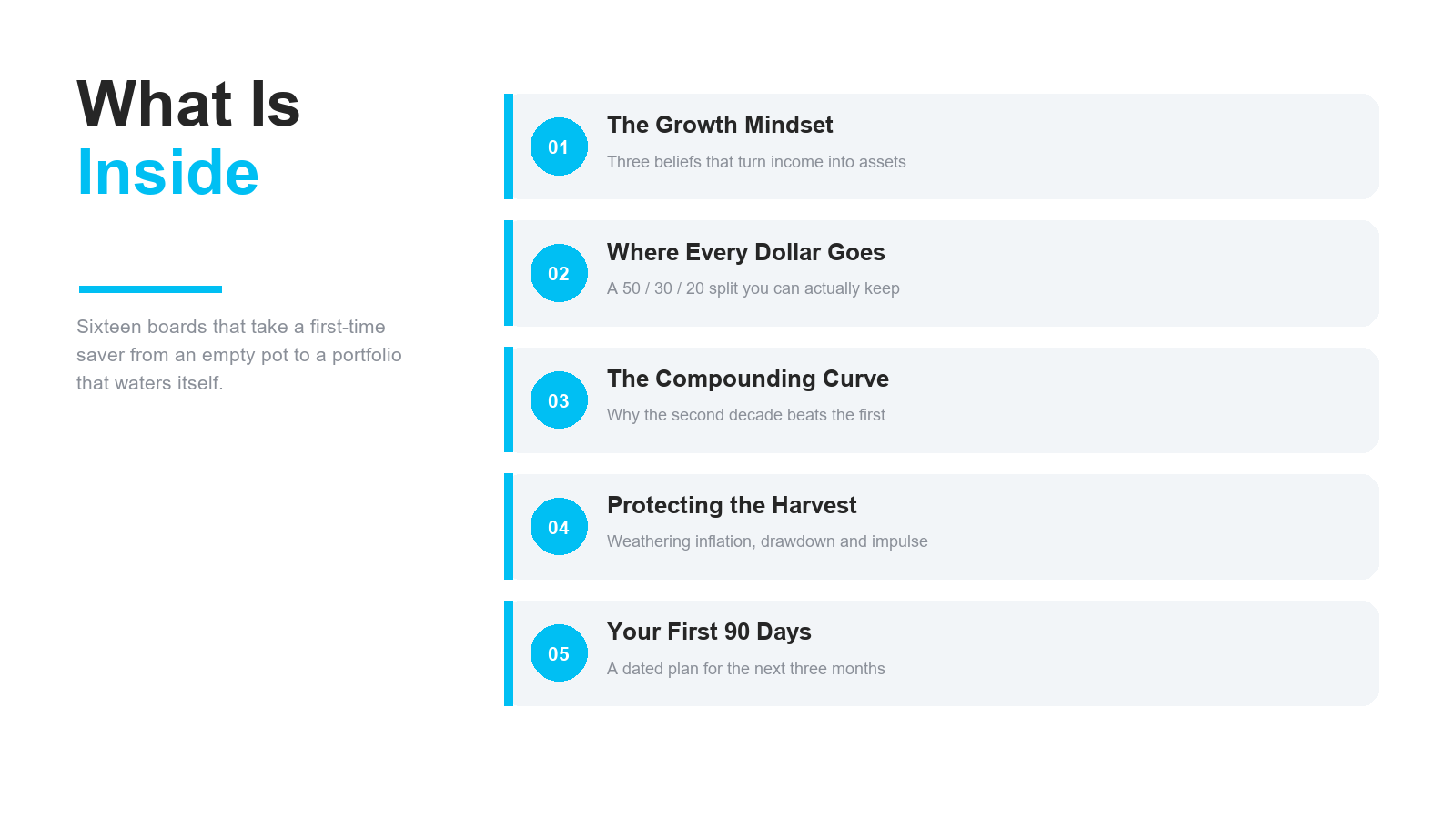
Sixteen boards, arranged as one argument rather than a loose collection.
Cover and contents (1–2) preview the five sections that follow — mindset, spending split, compounding, protection and the first 90 days.
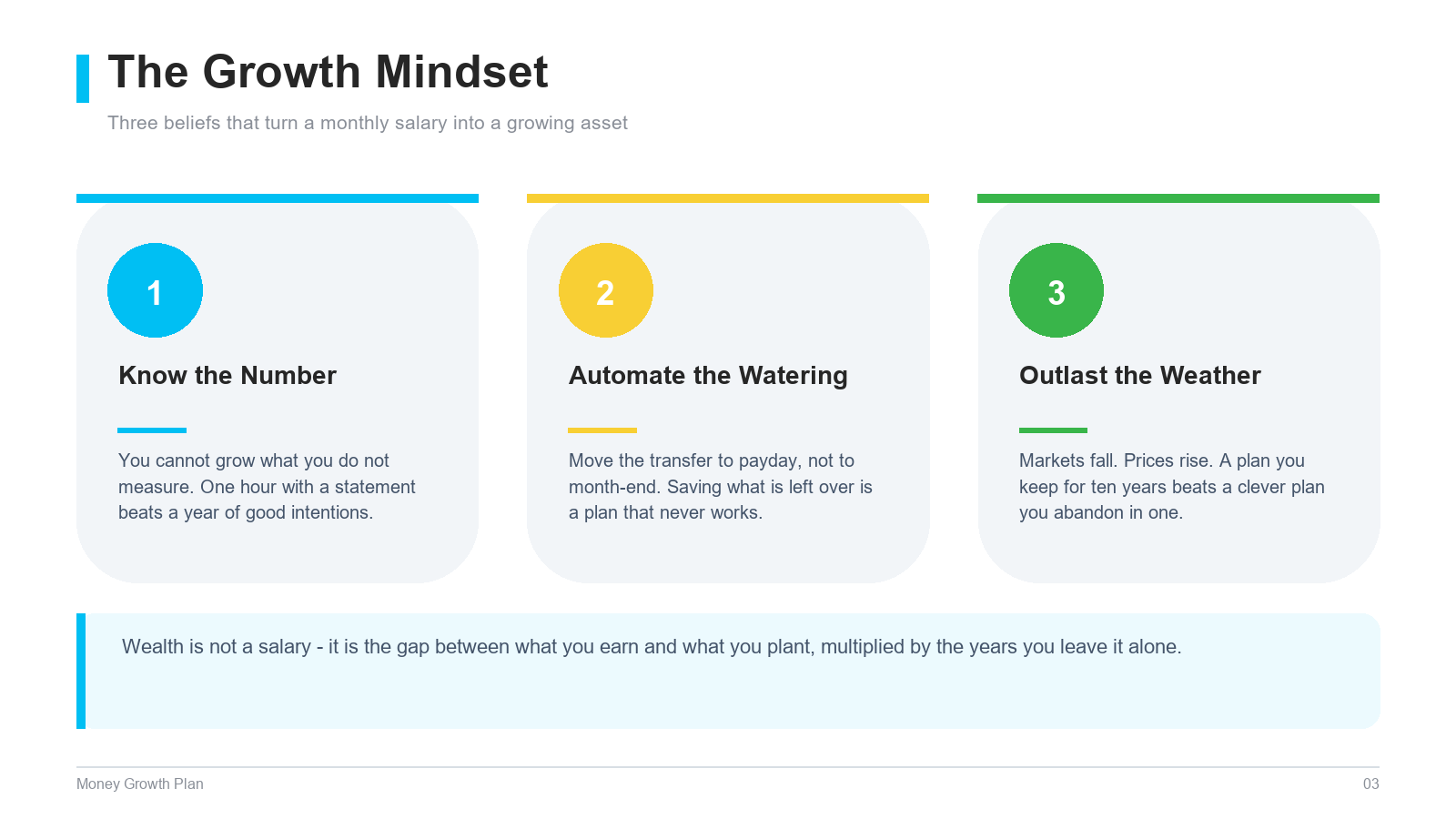
The Growth Mindset (3) sets out three beliefs that turn a monthly salary into a growing asset: know the number, automate the watering, outlast the weather.
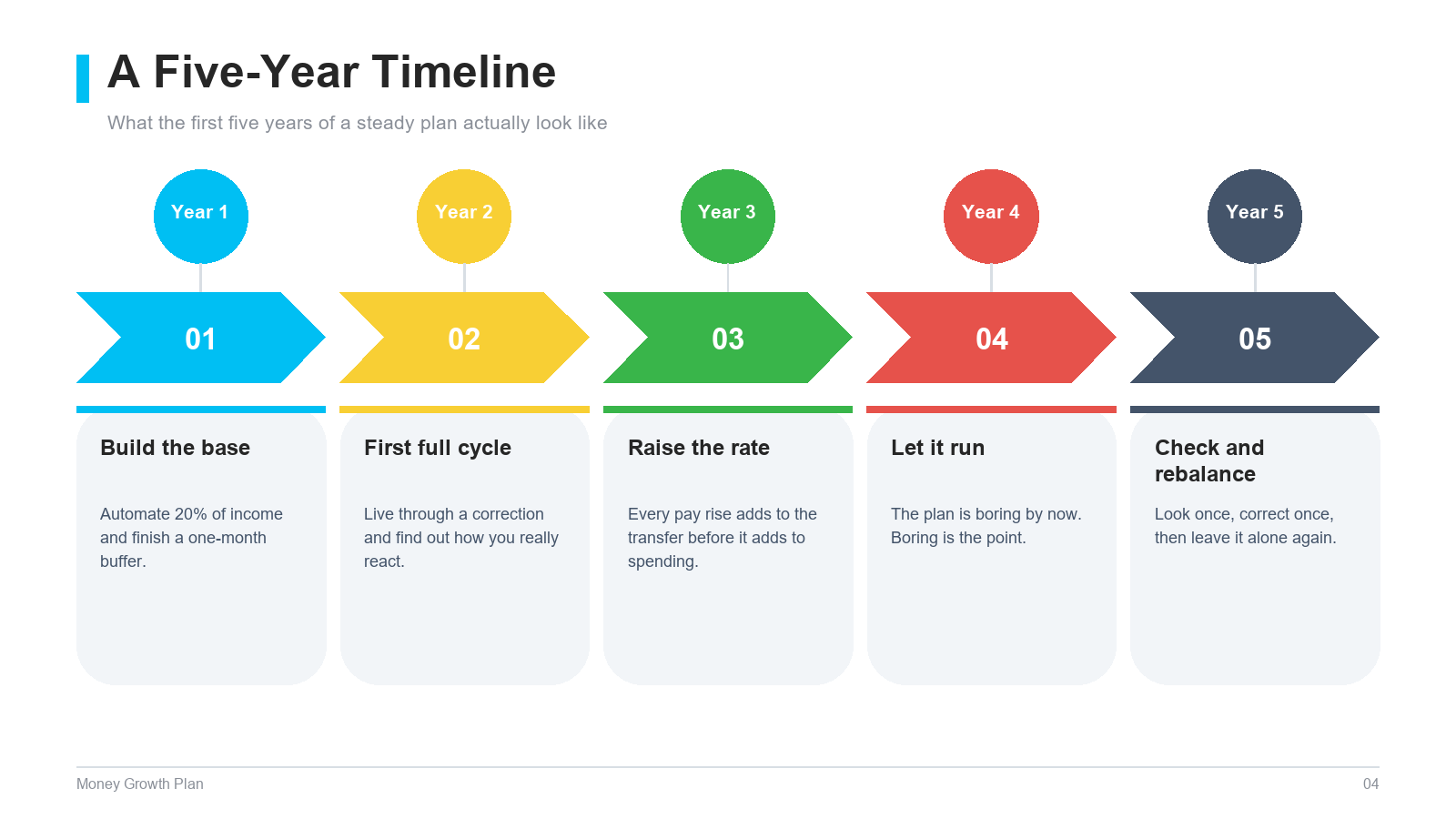
A Five-Year Timeline (4) runs years one to five as a chevron sequence — build the base, live through a correction, raise the rate with every pay rise, then leave it alone.
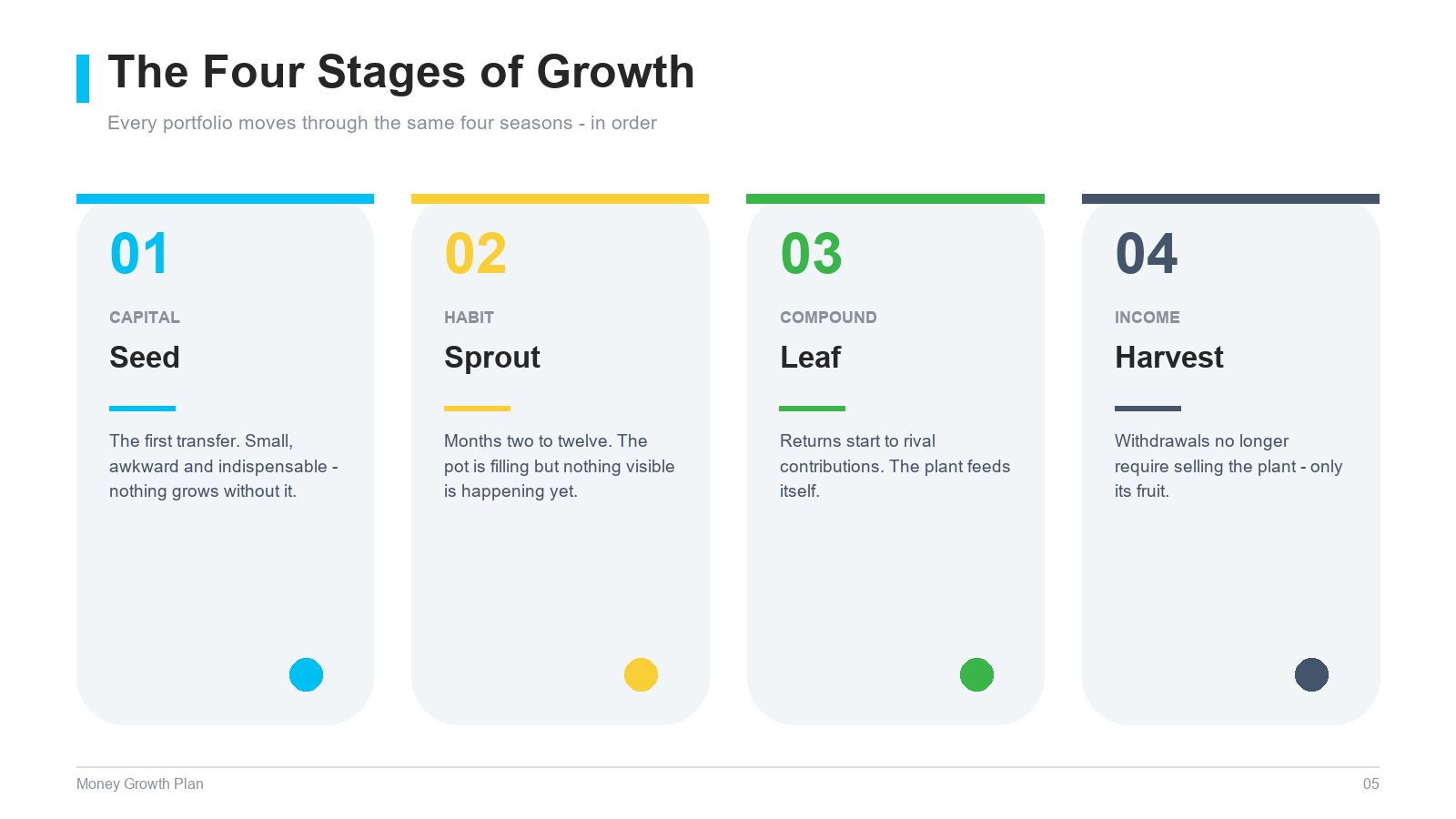
Four Stages of Growth (5) names the seasons every portfolio passes through in order: Seed, Sprout, Leaf, Harvest.
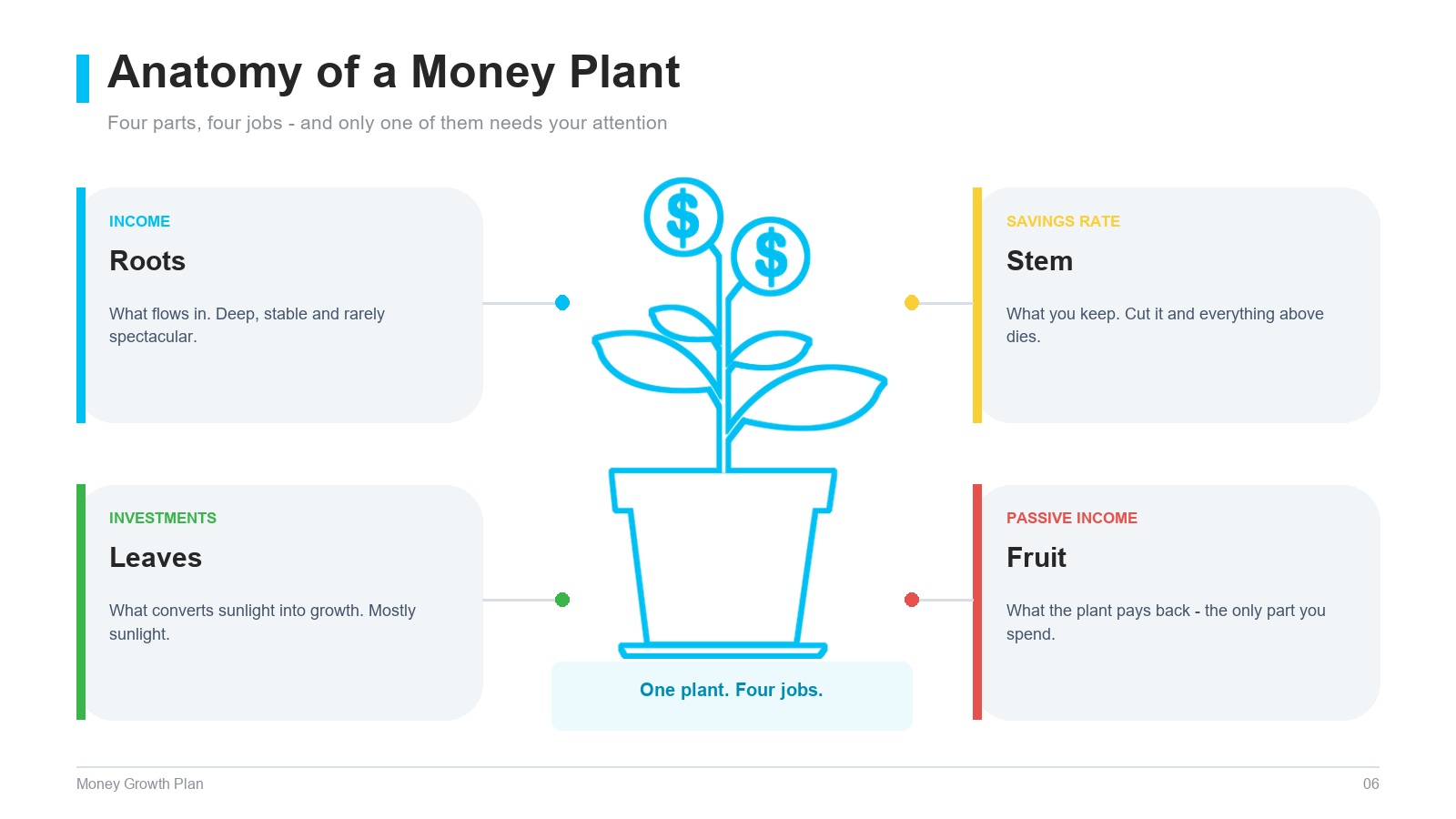
Anatomy of a Money Plant (6) maps four parts to four jobs — income as roots, savings rate as the stem, investments as the leaves, passive income as the fruit — and notes that only one needs your attention.
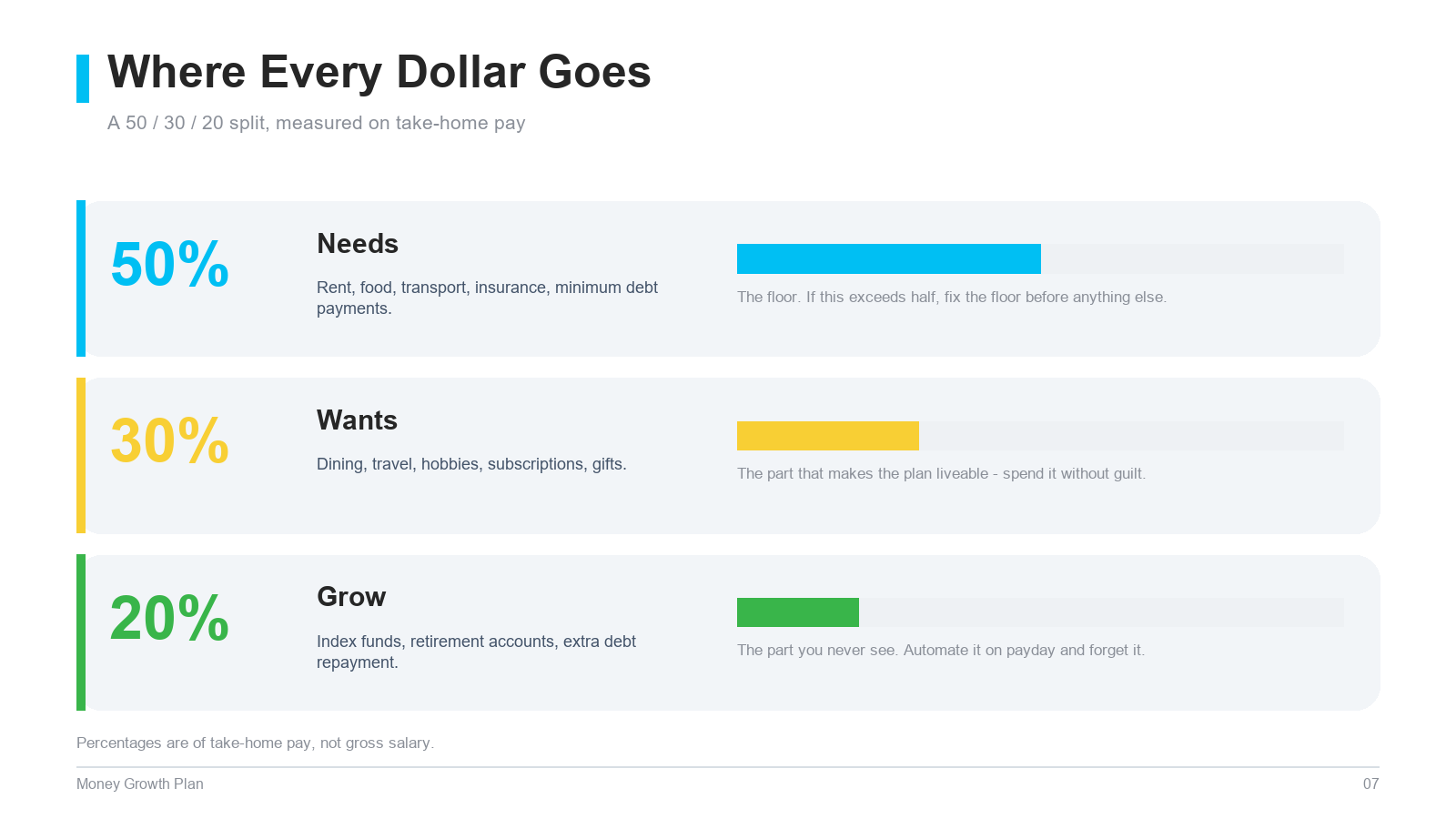
Where Every Dollar Goes (7) splits take-home pay 50 / 30 / 20 with a plain explanation of each band.
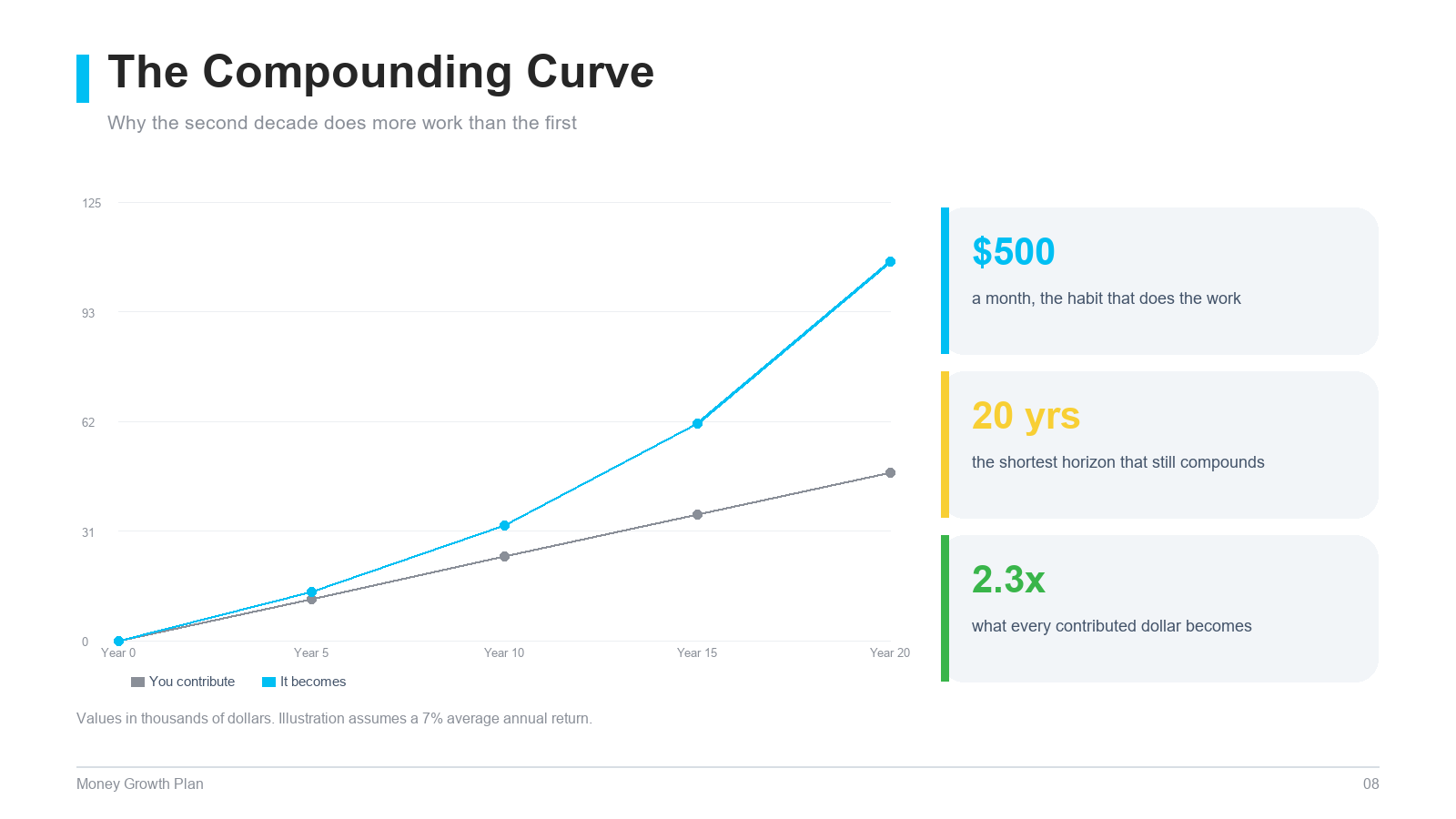
The Compounding Curve (8) is a native line chart of $500 a month over twenty years — $48,000 contributed, roughly $108,000 at the end — with the headline that each contributed dollar becomes about 2.3 times itself.
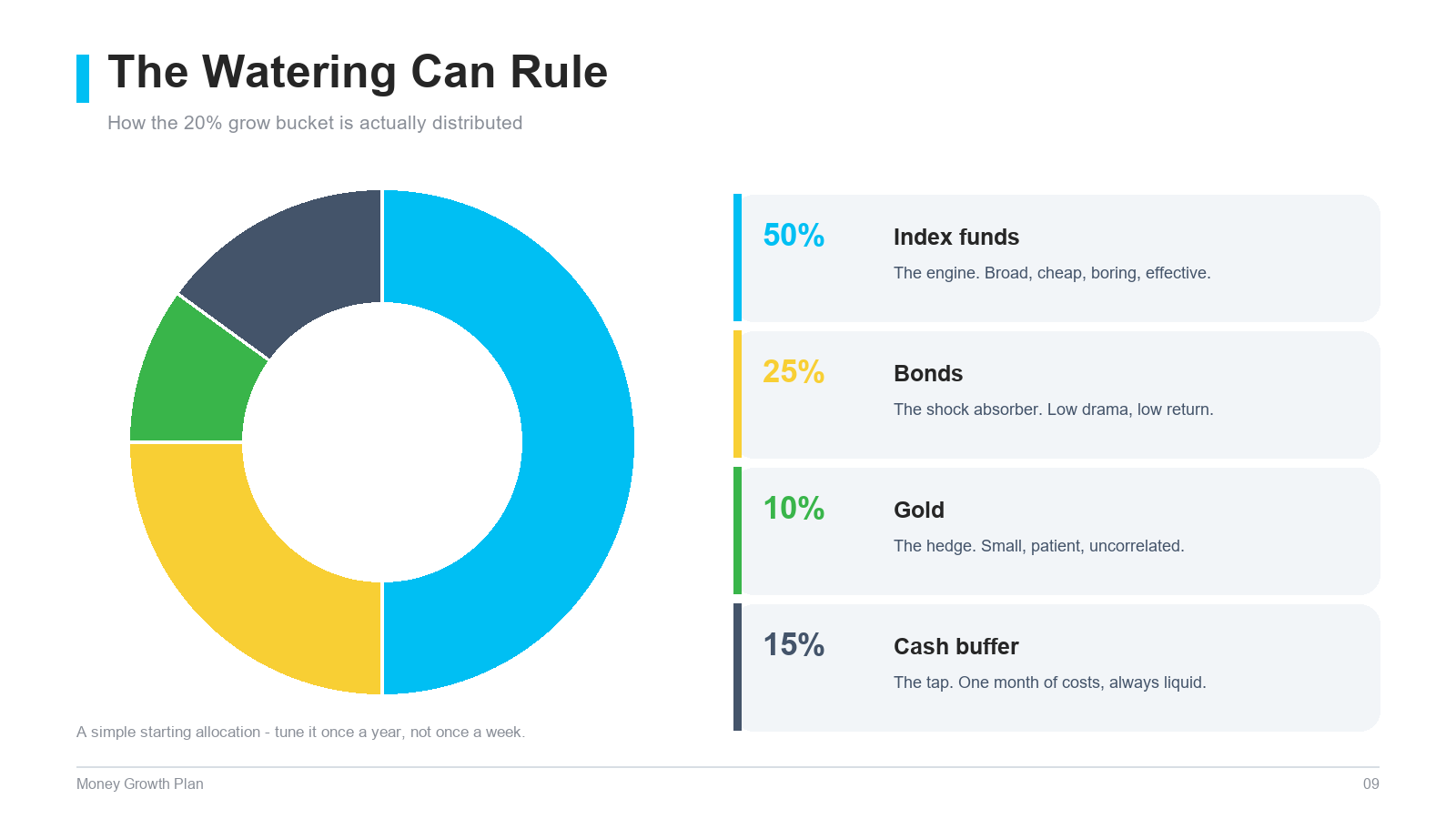
The Watering Can Rule (9) is a doughnut chart dividing the 20% growth bucket across index funds, bonds, gold and a cash buffer, with a note to tune it once a year, not once a week.
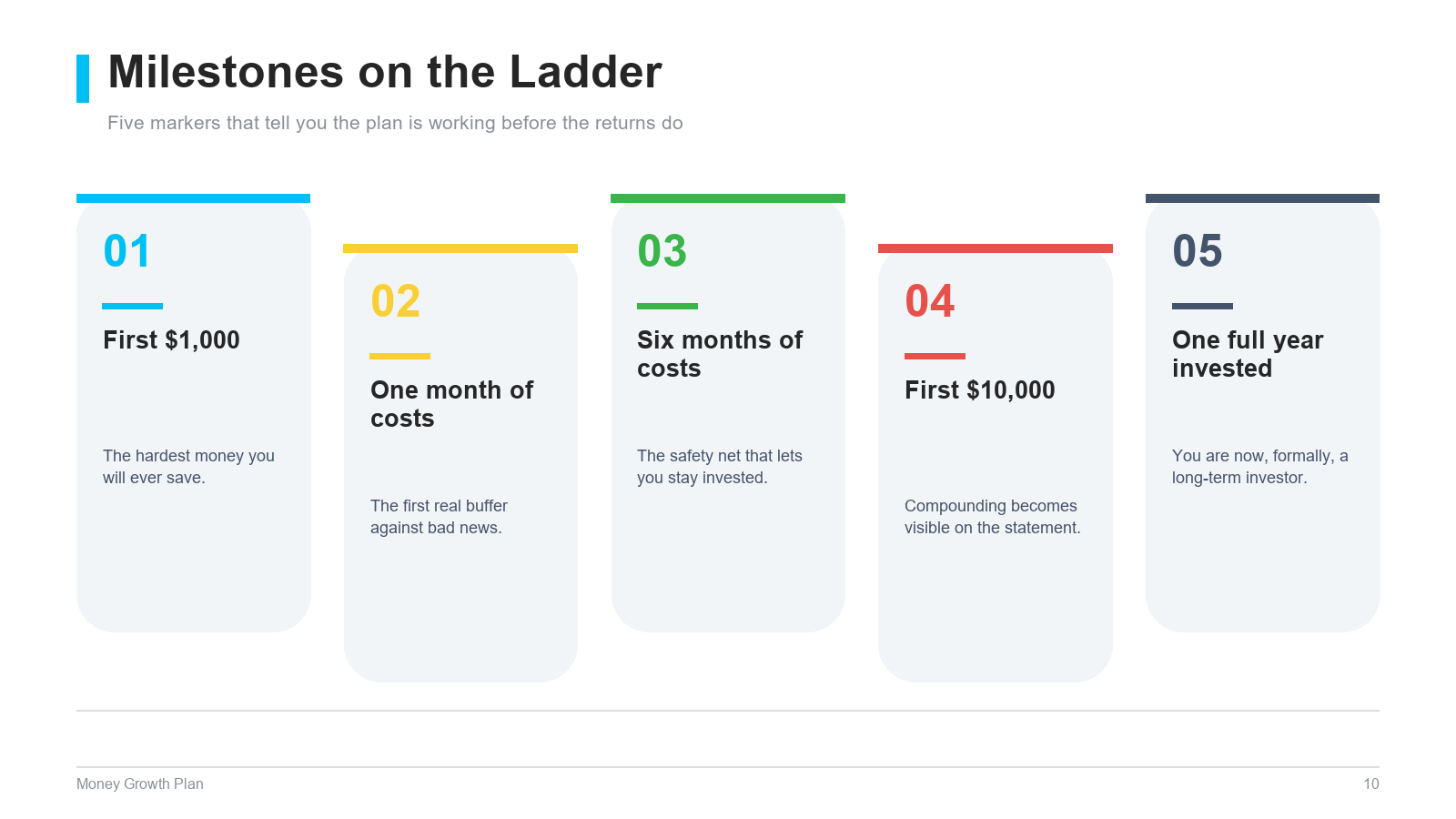
Milestones on the Ladder (10) lists five markers that prove the plan is working before the returns do: the first $1,000, one month of costs, six months of costs, the first $10,000, one full year invested.
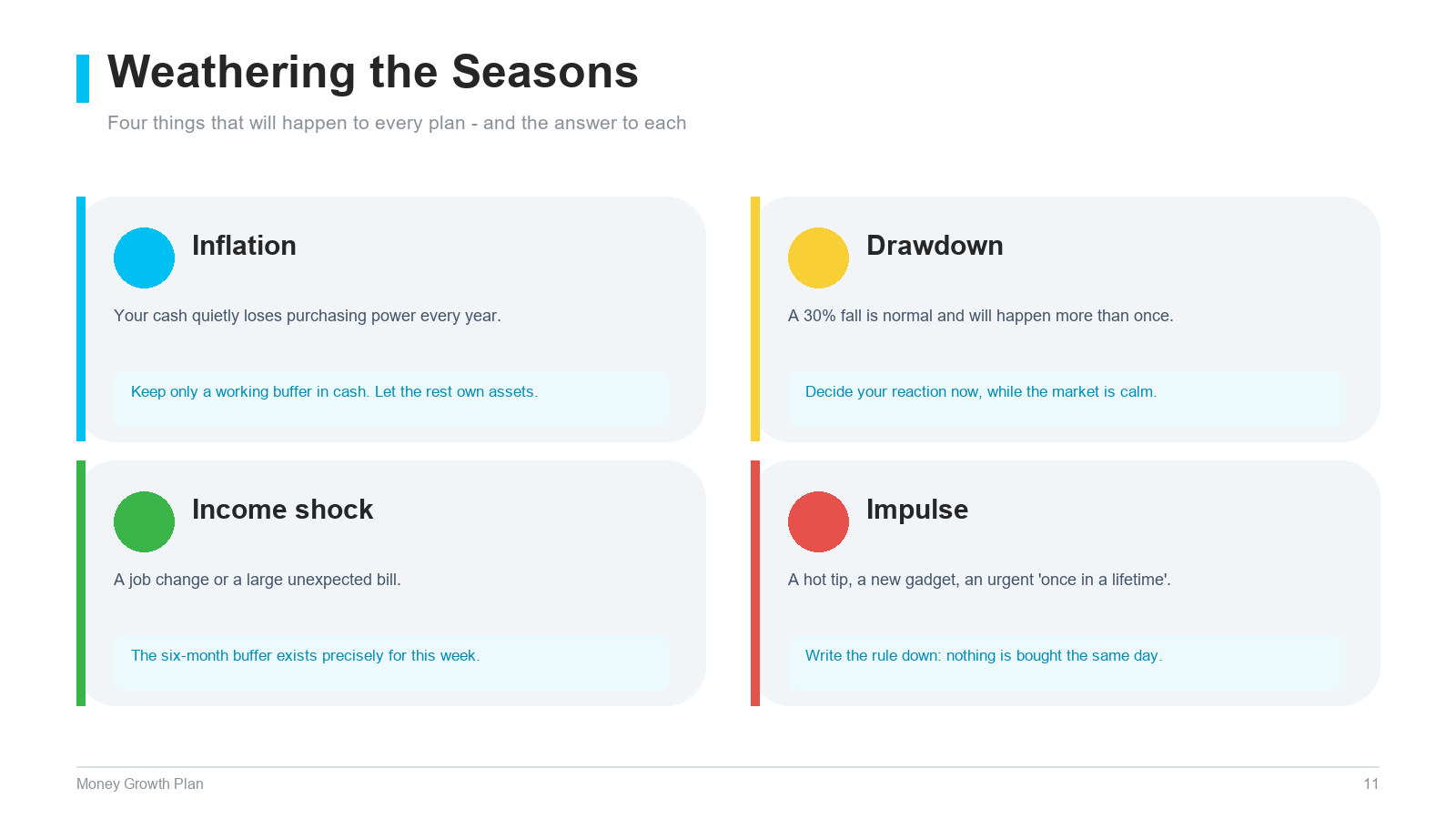
Weathering the Seasons (11) pairs the four shocks every plan meets — inflation, drawdown, an income shock, impulse spending — with a one-line response to each.
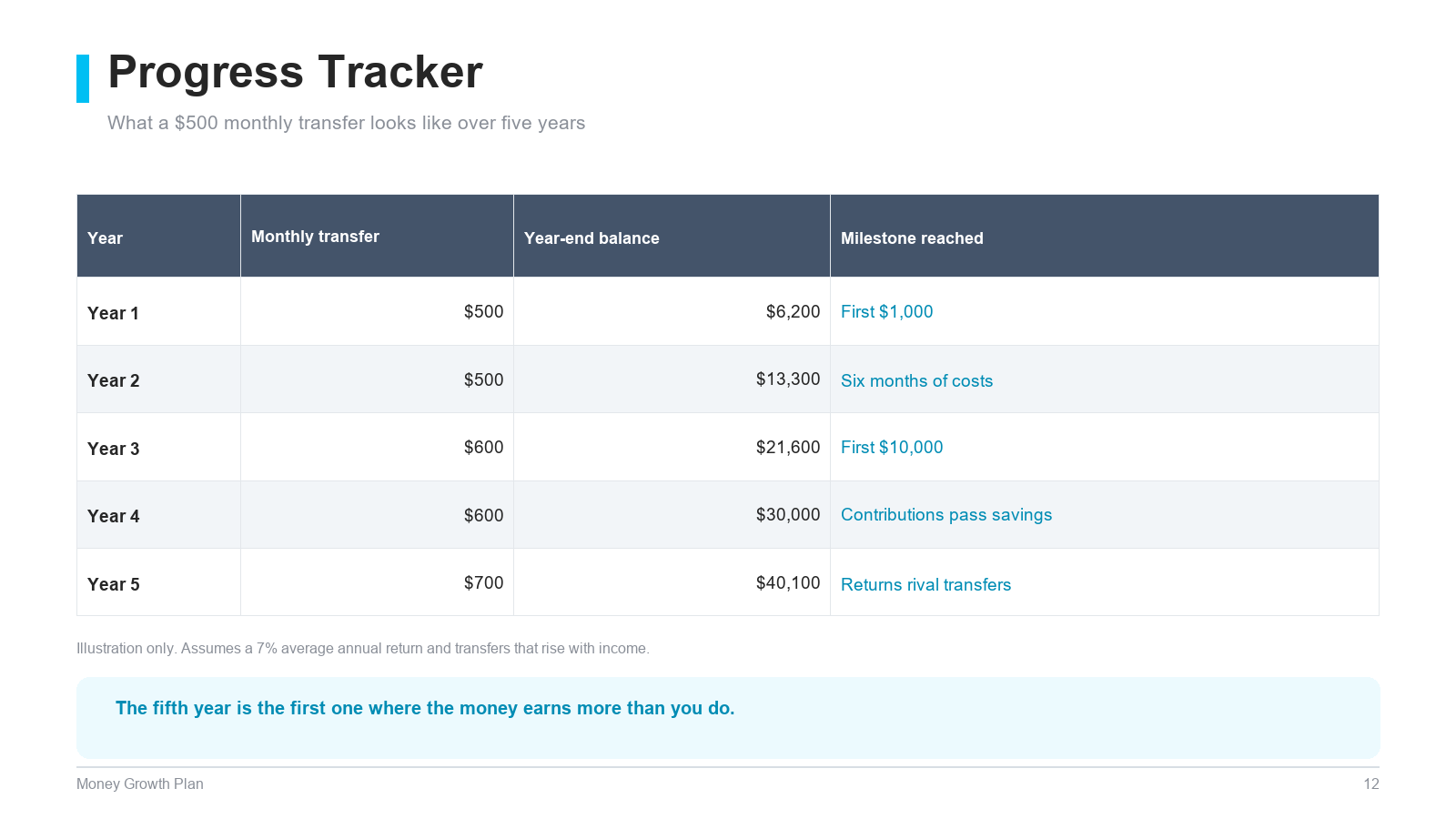
Progress Tracker (12) is an editable five-row table setting a rising monthly transfer against year-end balances.
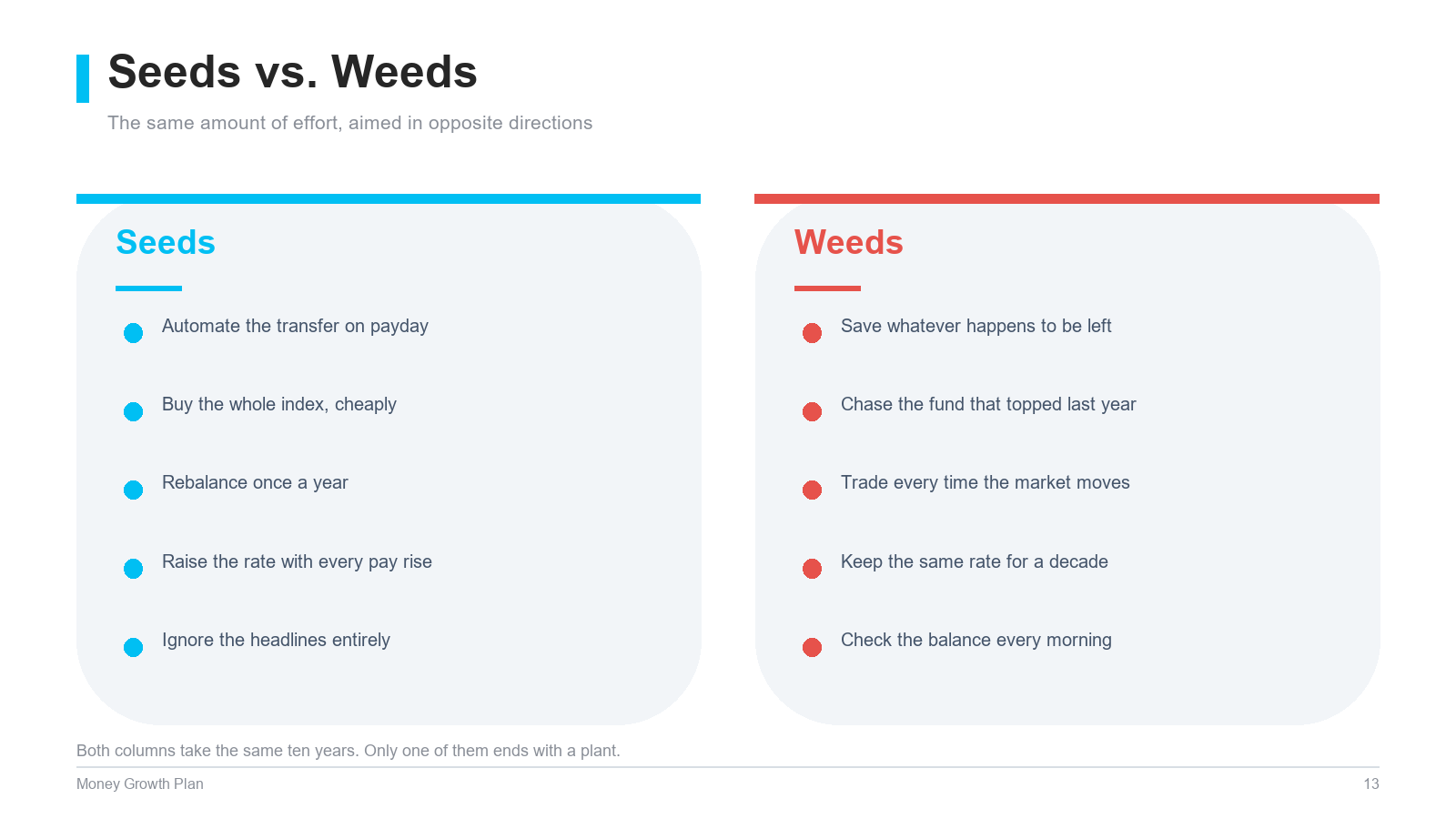
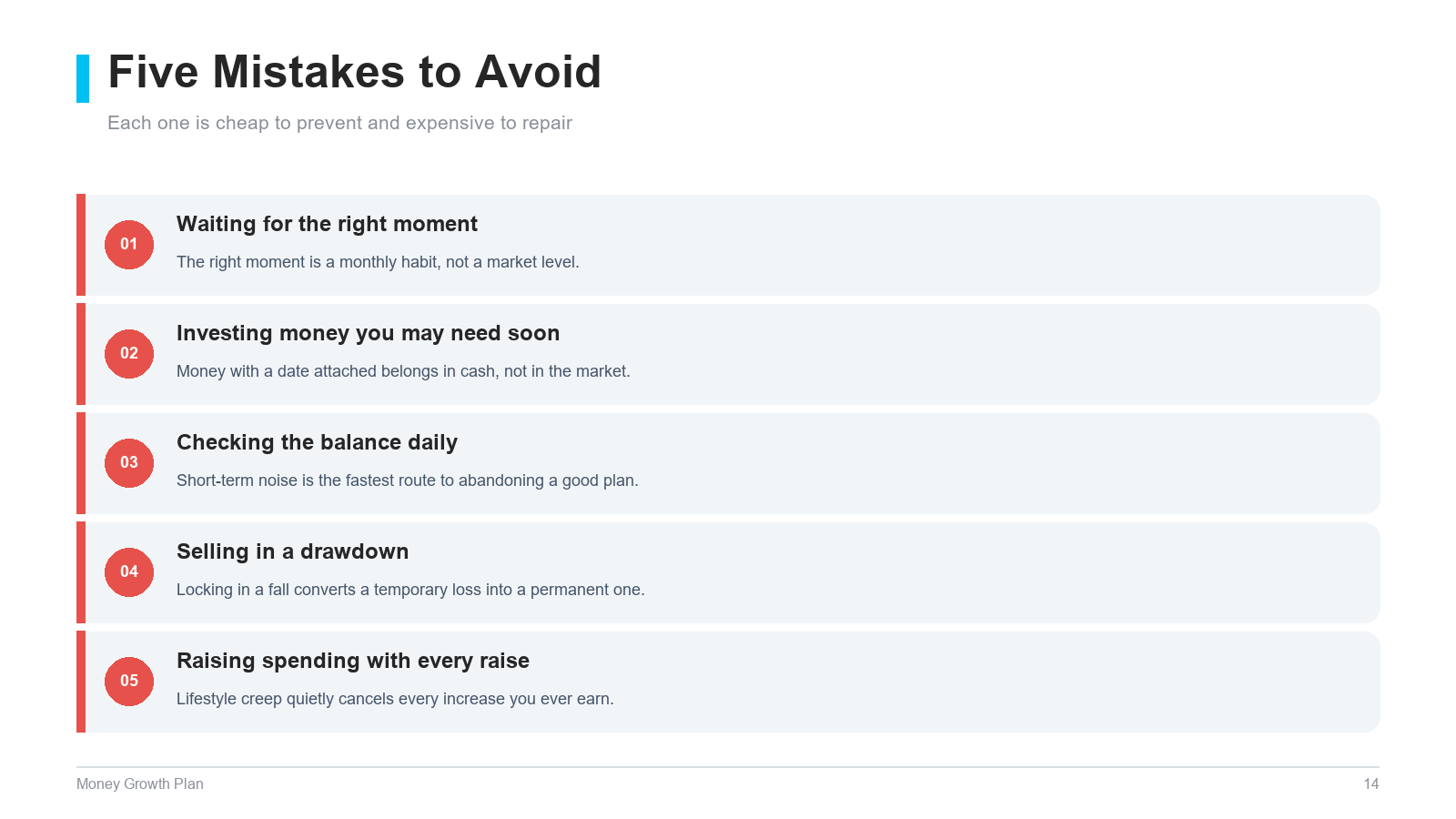
Seeds vs. Weeds (13) and Five Mistakes to Avoid (14) turn the same habits and errors into two comparison layouts.
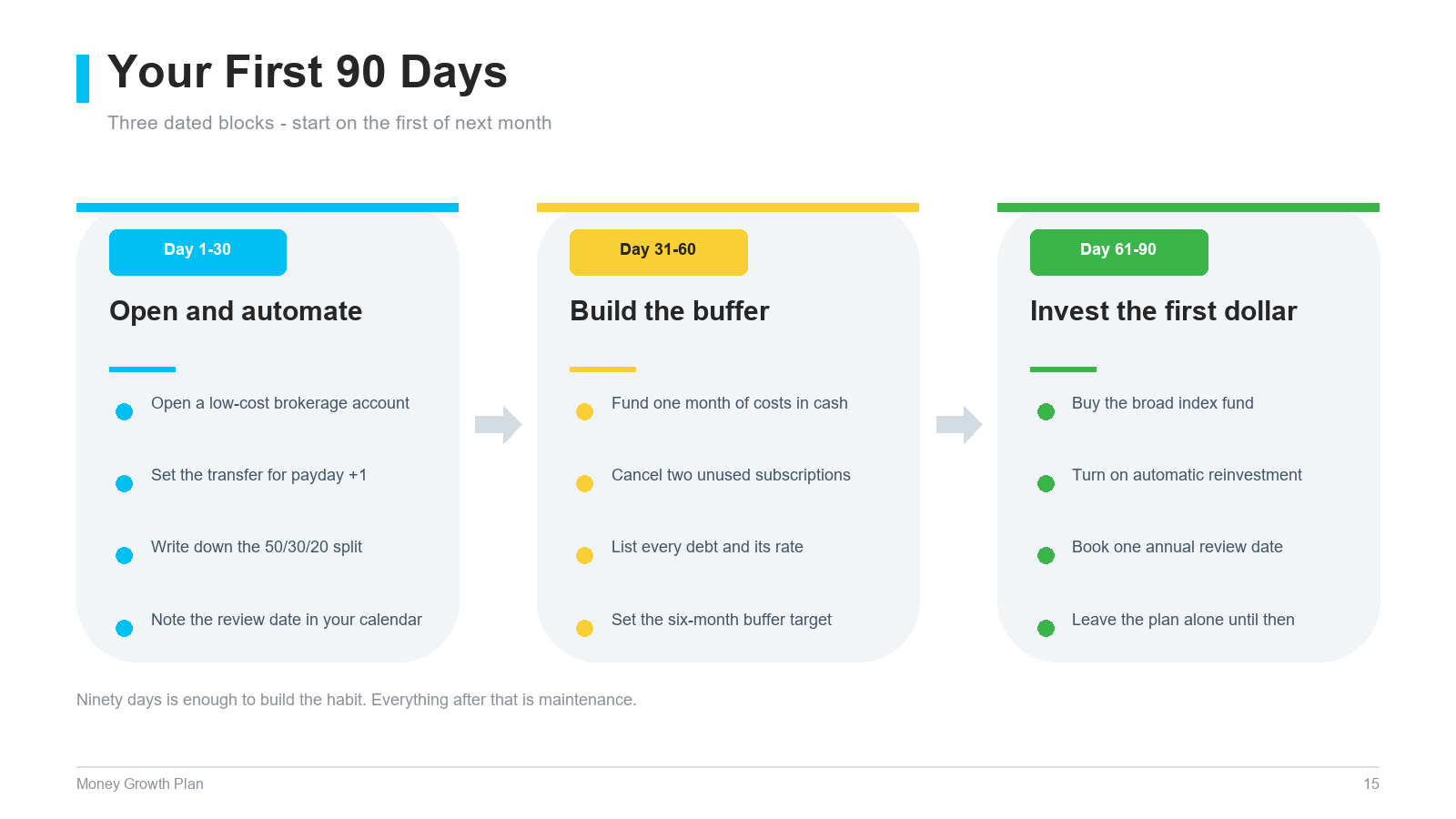
Your First 90 Days (15) converts all of it into three dated blocks — open and automate, build the buffer, invest the first dollar.
The closing board (16) is a thank-you slide ready for your own logo or contact details.
Two native charts, one table, one timeline, one four-part diagram and two comparison layouts — all built from ordinary shapes and placeholders, so nothing breaks when you edit it.
Who It’s For
Money Growth Plan suits anyone who has to explain saving and investing to people who are new to it. Financial advisers and wealth planners get a structured, non-technical narrative for an introductory meeting. Personal-finance educators, course creators and workshop hosts get a deck that survives being read aloud — the metaphor does much of the explaining. Banks, credit unions, robo-advisers and employee financial-wellness programmes can use it for in-house sessions or client education, and owners running their first savings plan can adapt it for their own team.
Because the template names no products, tickers or jurisdiction-specific rules, the content travels: change the currency, adjust the allocation, replace the illustrative 7% return assumption with your own, and it reads as locally written. The 50 / 30 / 20 split, the milestone ladder and the 90-day plan are ordinary working defaults, not prescriptions.
Use it as a finished presentation, or take it apart board by board as a starting kit for something longer. Either way the message stays the same as the closing line: start small, stay long.


Related Posts