PiPlan Savings Plan
September 30, 2026 by Ryan
PiPlan Savings Plan
What It Is
PiPlan Savings Plan is a 15-page English language PowerPoint deck that turns “I really should save more” into a method you can actually follow. It was built as an original design modelled on the visual language of a widely used personal-finance template — the same 16:9 canvas, the same left-aligned title bar with a small accent block, the same circular numbered nodes and connecting lines — but the source’s four-colour palette of orange, purple, yellow and pink has been deliberately compressed into a single warm-orange ramp supported by neutral greys. The result looks calm and deliberate rather than decorative, which matters for a topic that asks a reader to change their behaviour.
The deck is not a sales pitch, and it recommends no specific fund, bank or app. It teaches a sequence. Every page assumes a salaried individual who wants a repeatable system for their own money, and each page is designed to be understood in seconds: one clear headline, one supporting line, and a single visual device — a numbered timeline, a three-column stack, an oversized number, a comparison pair, a progress bar, a donut chart, or a five-row action table. Nothing on a page competes with anything else, because the reader should be able to act on it afterwards.
The aesthetic choices are functional rather than ornamental. The warm-orange accent appears only where the deck wants attention — key figures, block headers, emphasis numbers — while body text stays near-black and captions recede into grey. Large decorative circles bleed off the canvas on the cover, the two section dividers and the closing page, giving a sense of movement without adding elements a presenter has to explain. Arial is used throughout, chosen because it is available on essentially every Windows and Office installation, so the deck will not silently reflow on someone else’s machine.
What’s Inside
The deck runs as a cover, contents page, two section dividers and eleven content pages, moving from diagnosis to action.
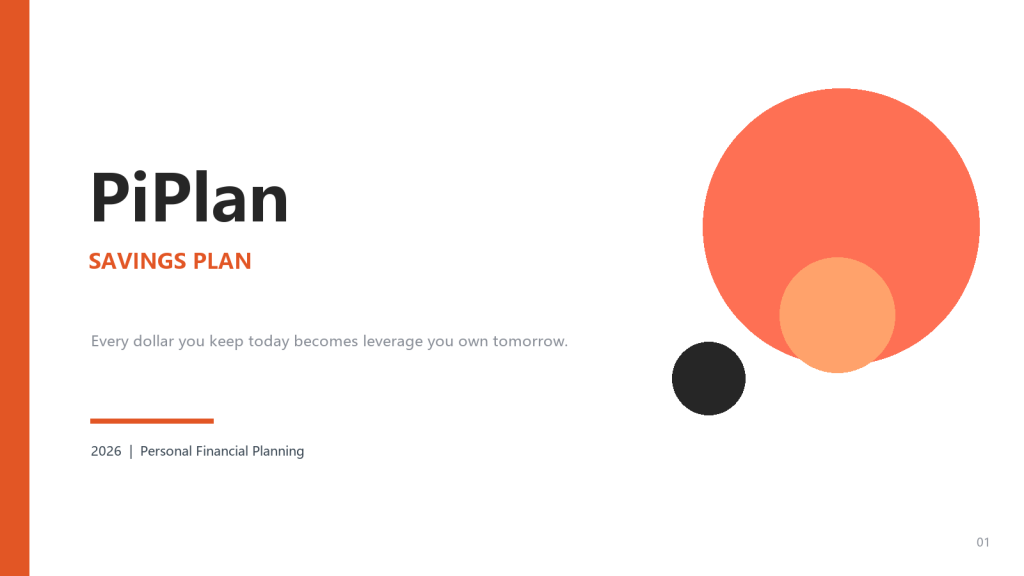
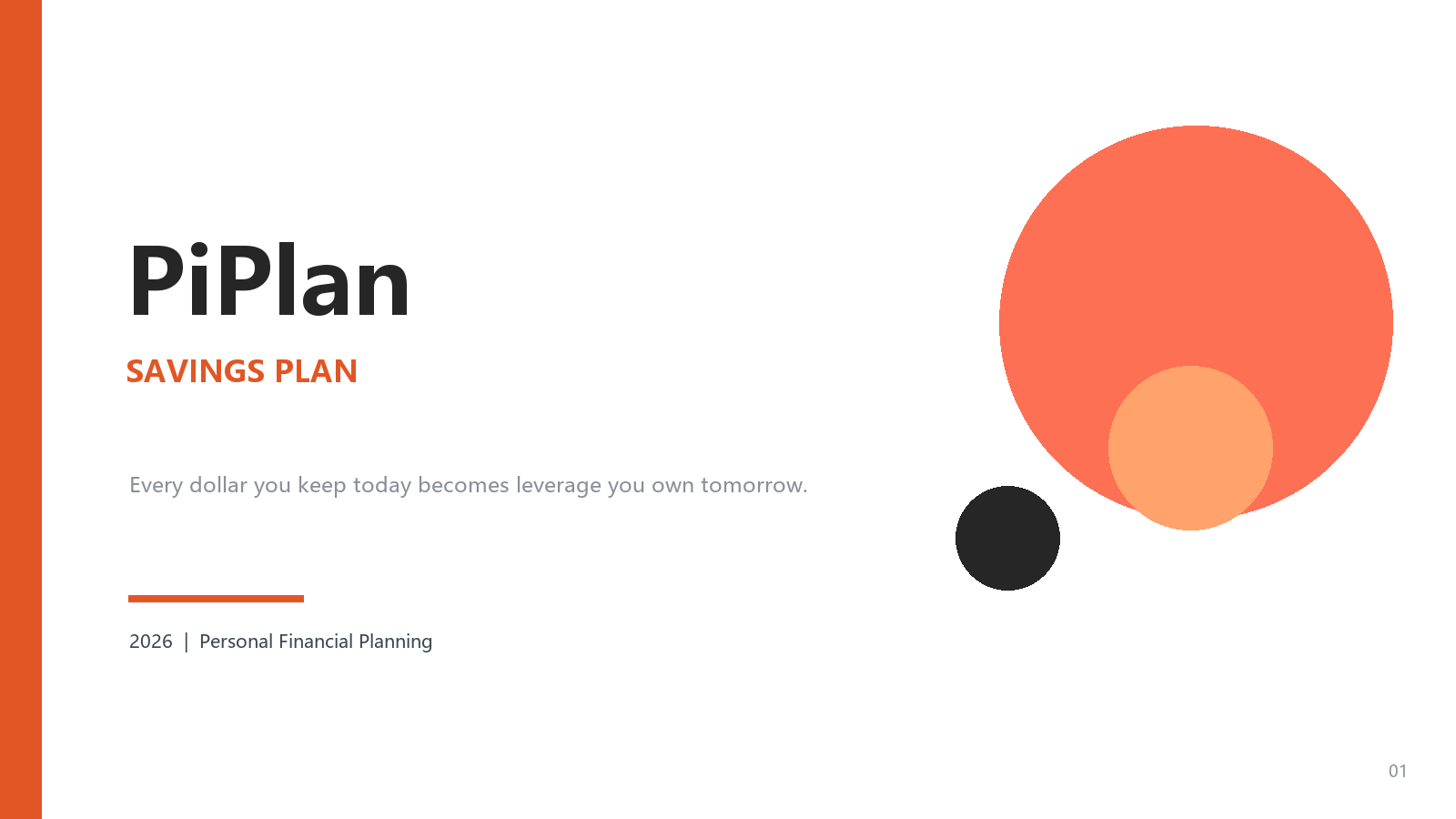
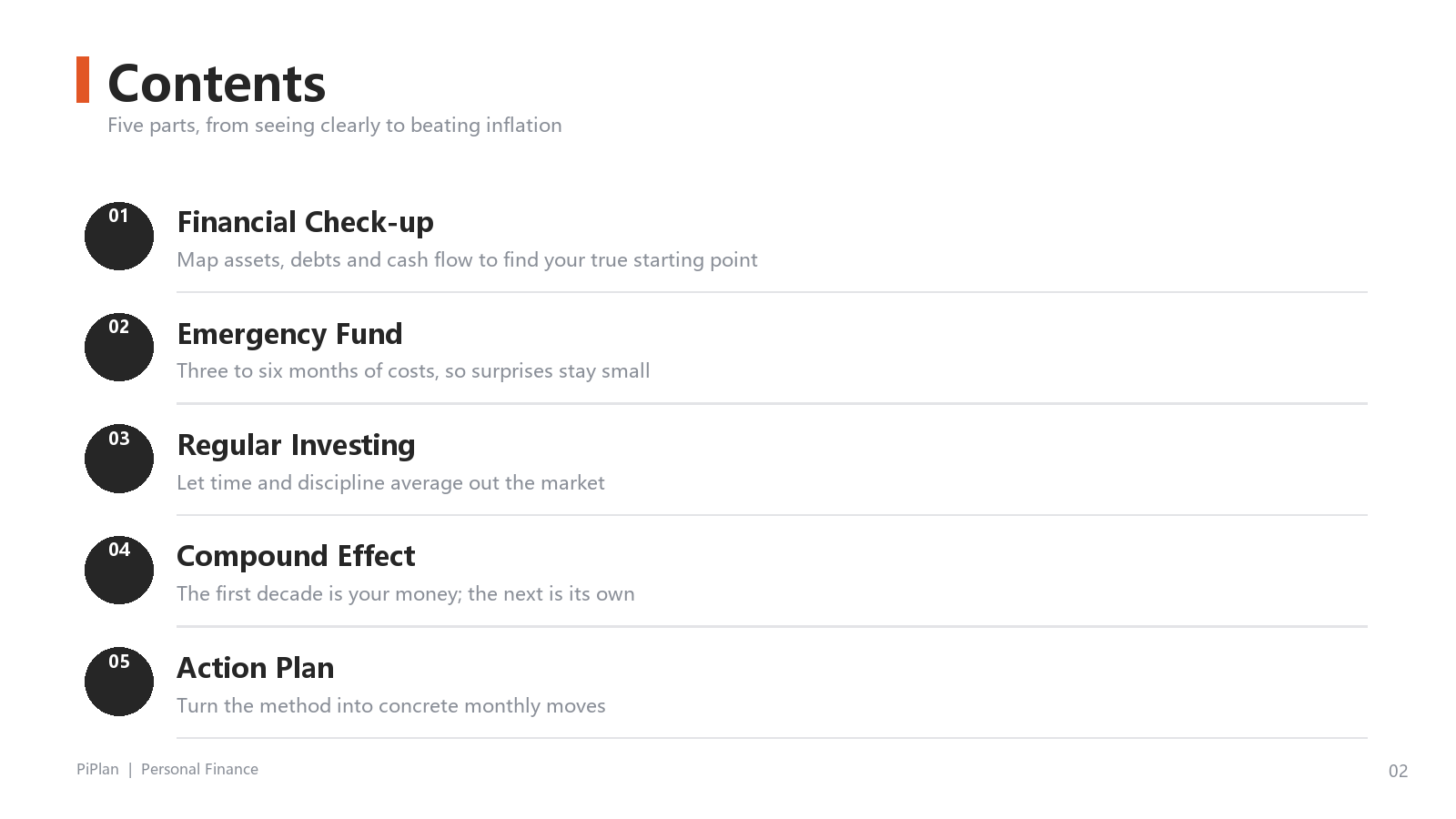
Pages 1–2 — Cover and Contents. The cover states the proposition plainly: “Every dollar you keep today becomes leverage you own tomorrow.” The contents page then previews five parts — Financial Check-up, Emergency Fund, Regular Investing, Compound Effect and Action Plan — each with a one-line promise.
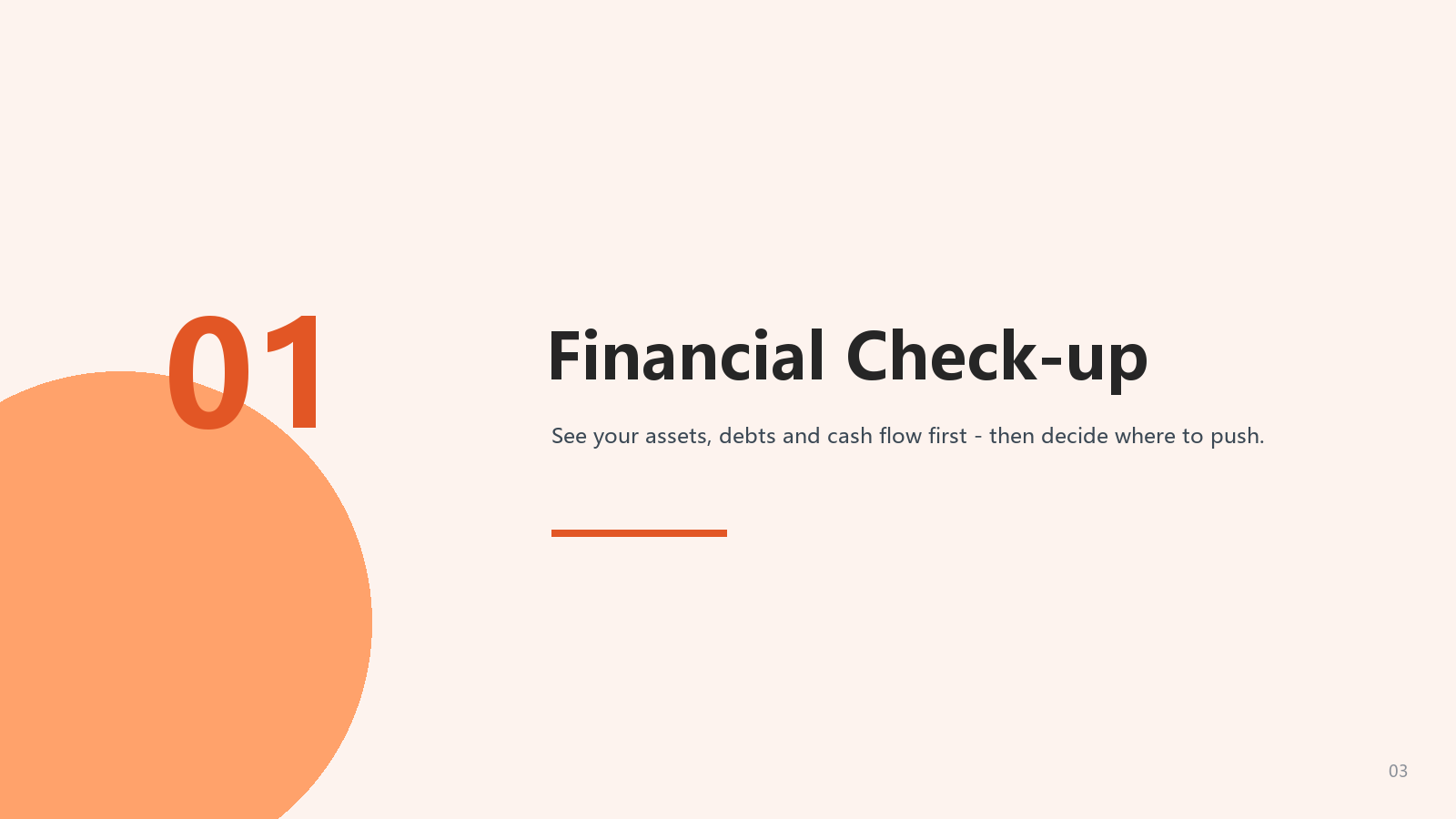
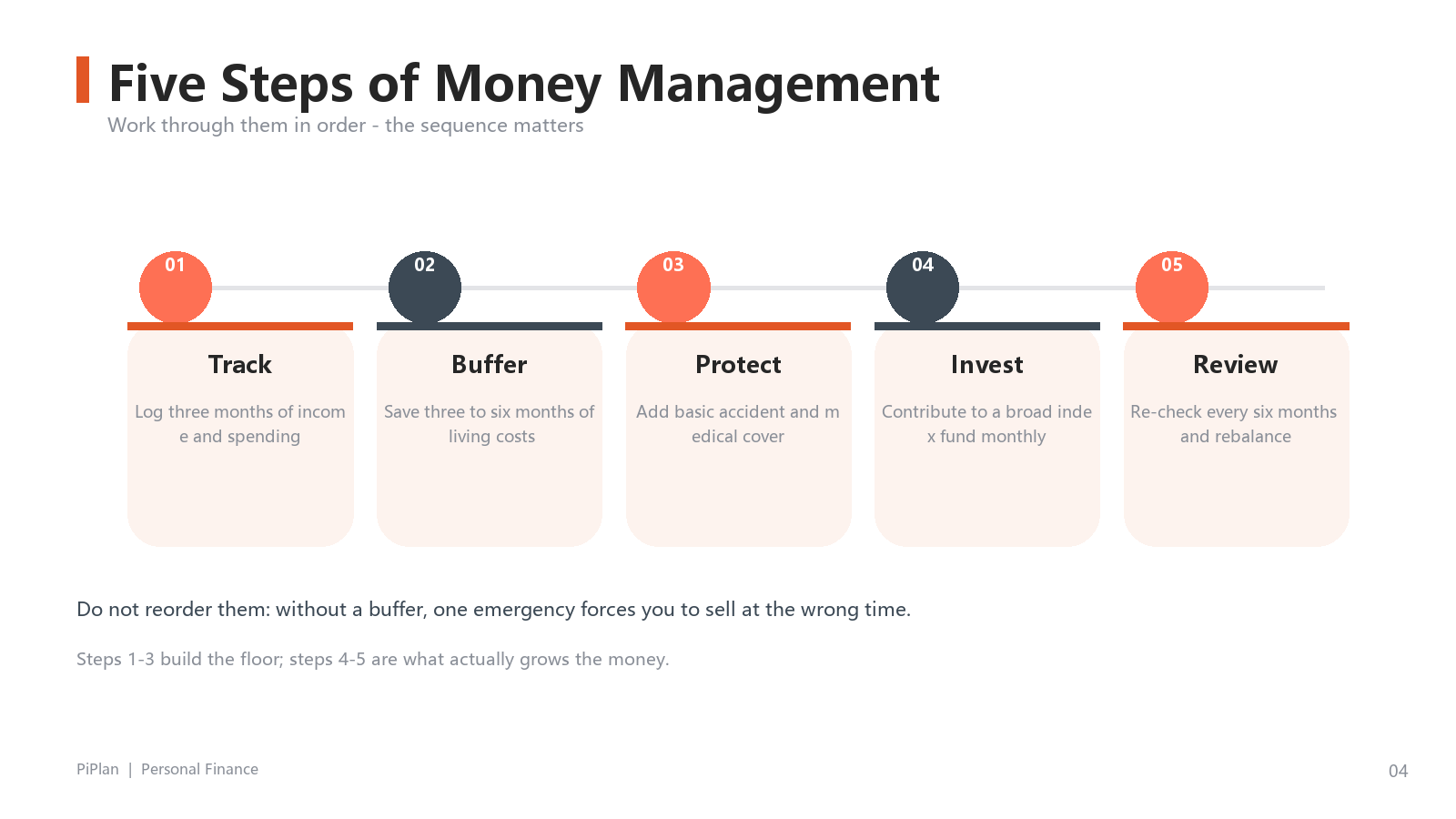
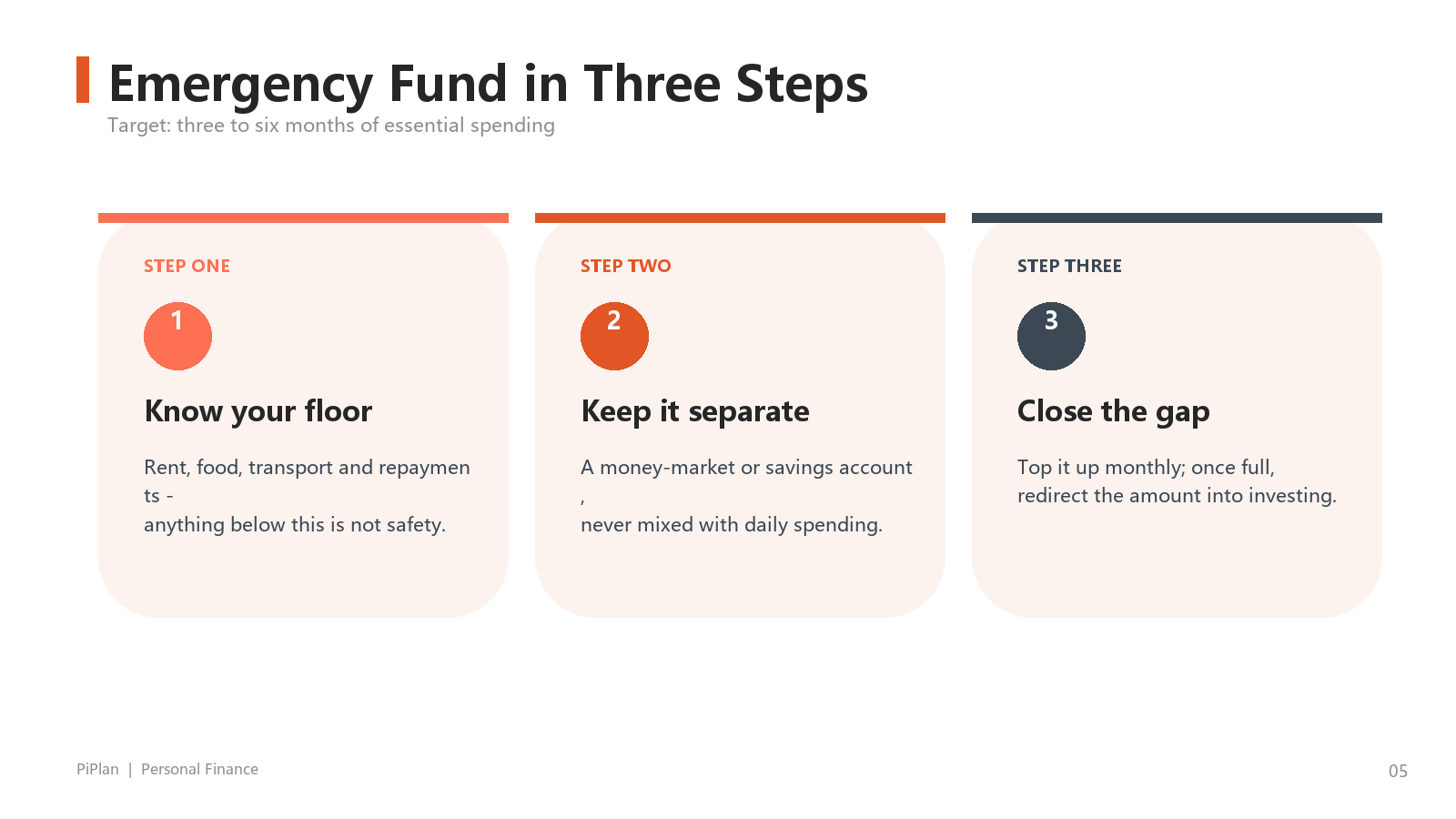
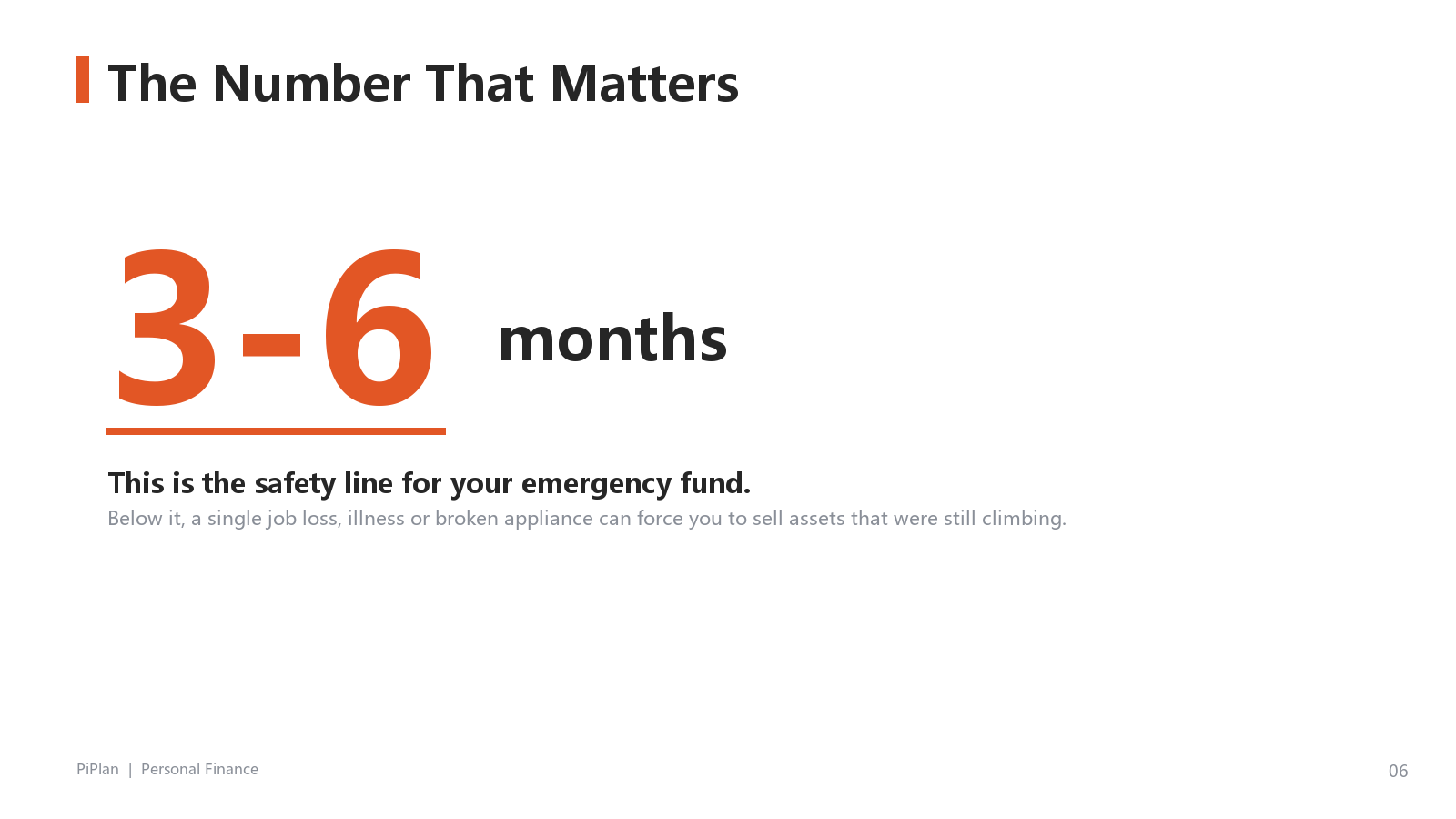
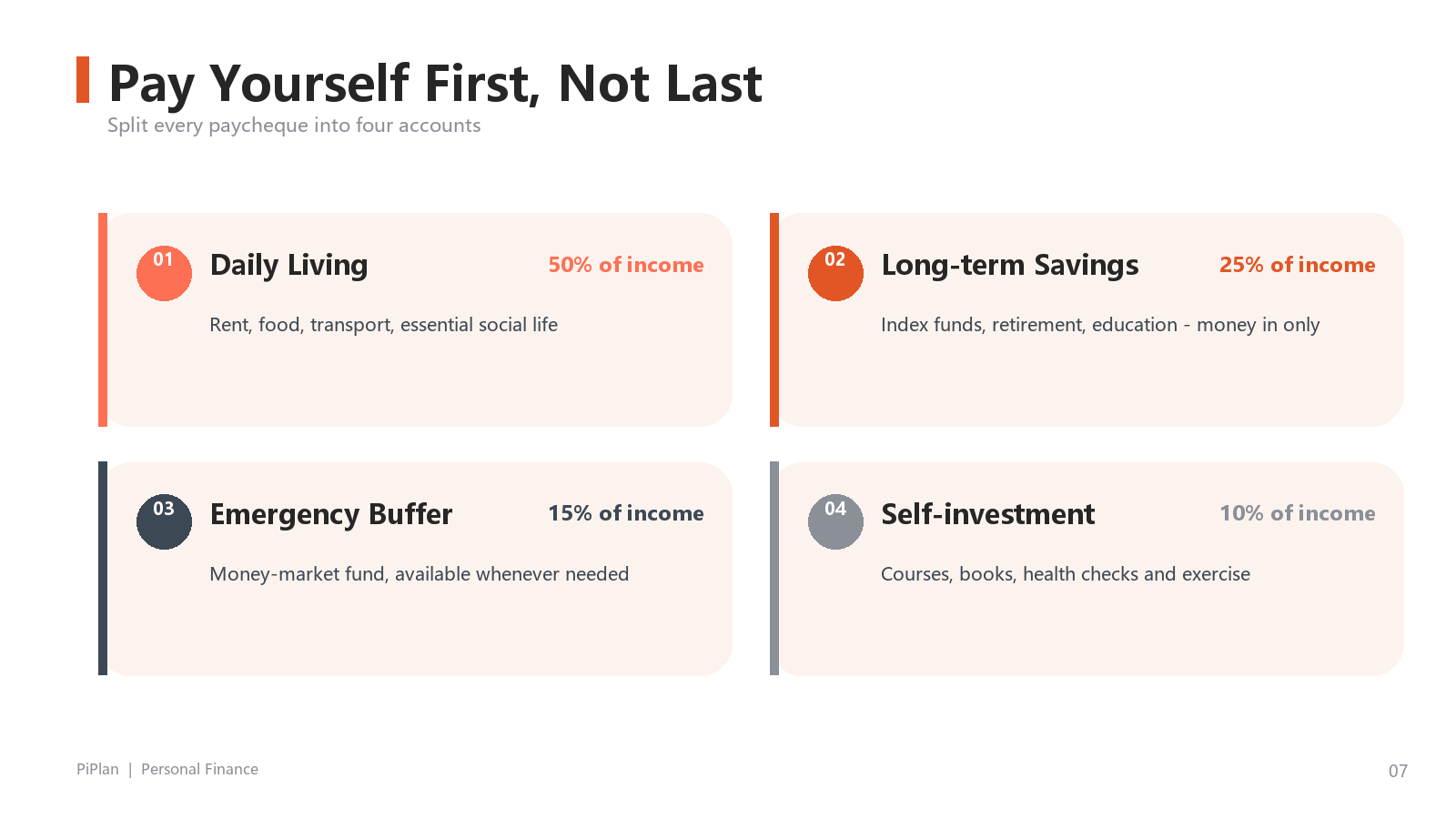
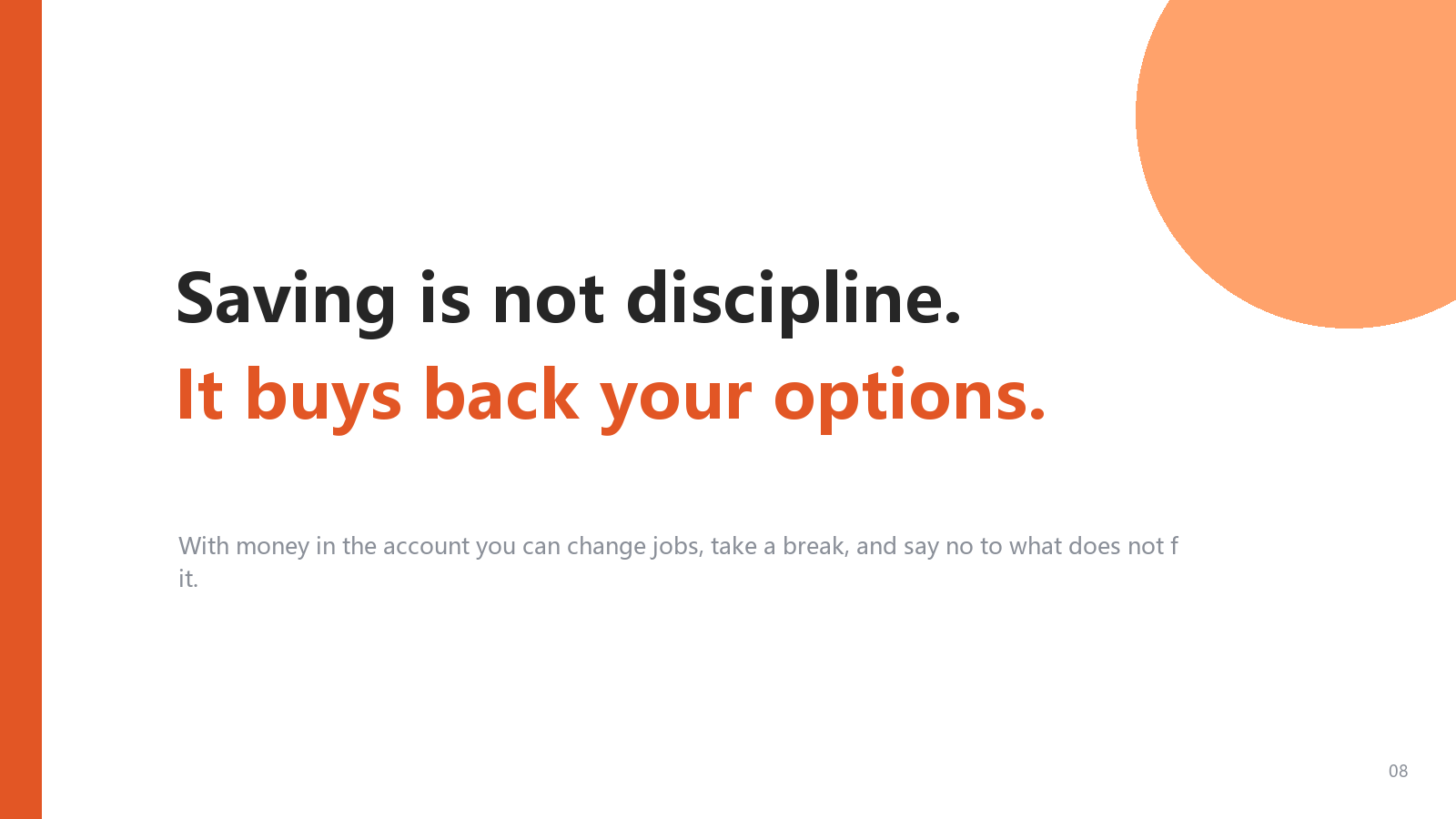
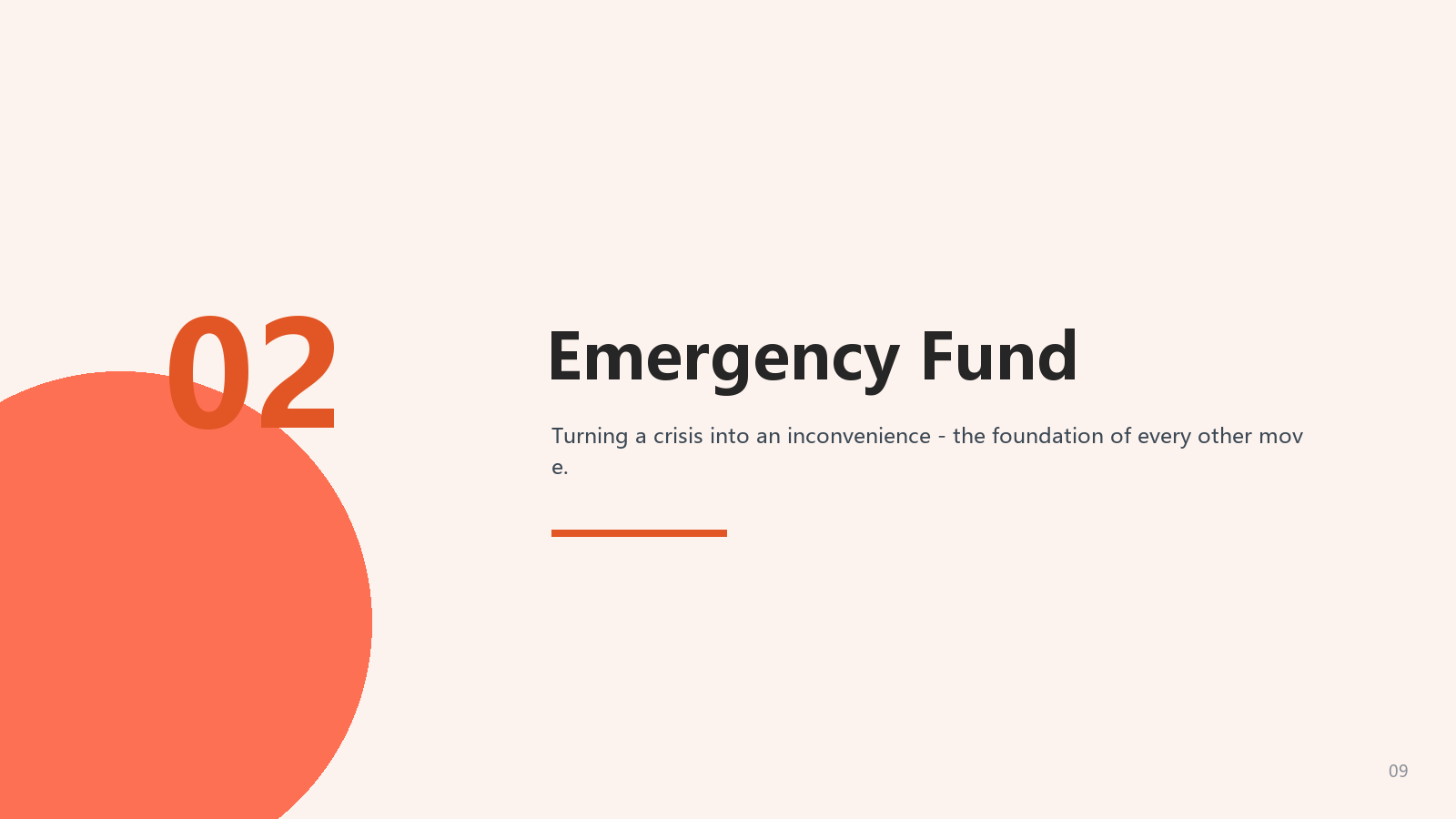
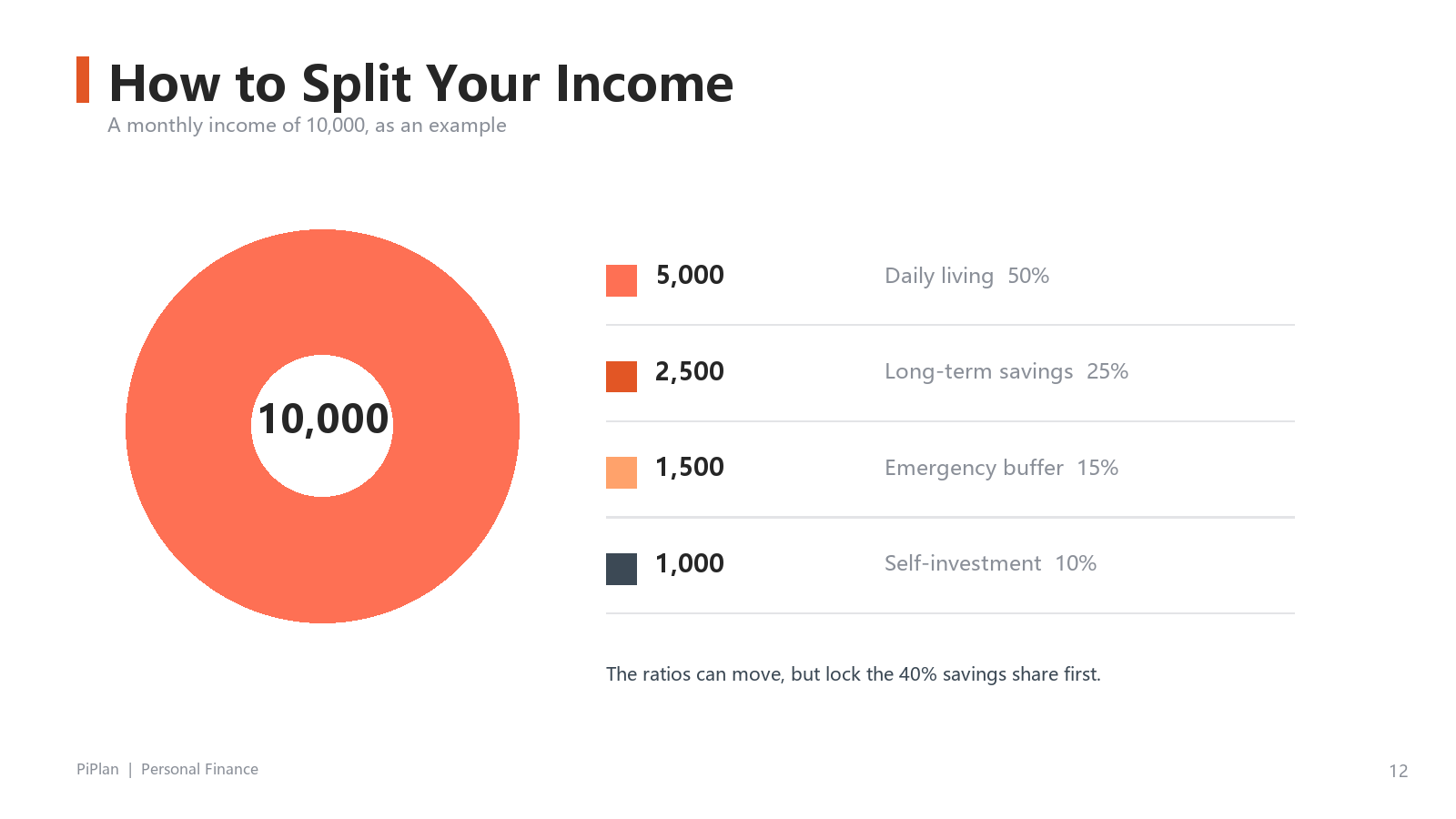
Pages 3–8 — Diagnosis and the foundation. Financial Check-up opens with the idea that you cannot decide where to push until you have mapped assets, debts and cash flow. Then Five Steps of Money Management — Track, Buffer, Protect, Invest, Review — runs along a horizontal timeline, deliberately in a fixed order, because without a buffer one emergency forces you to sell at exactly the wrong moment. Three pages follow on the emergency fund: a three-step build (know your floor, keep it separate, close the gap), an oversized “3–6 months” stating the safety line, and a four-account split of every paycheque — 50% daily living, 25% long-term savings, 15% emergency buffer, 10% self-investment. A statement page closes it: “Saving is not discipline. It buys back your options.”
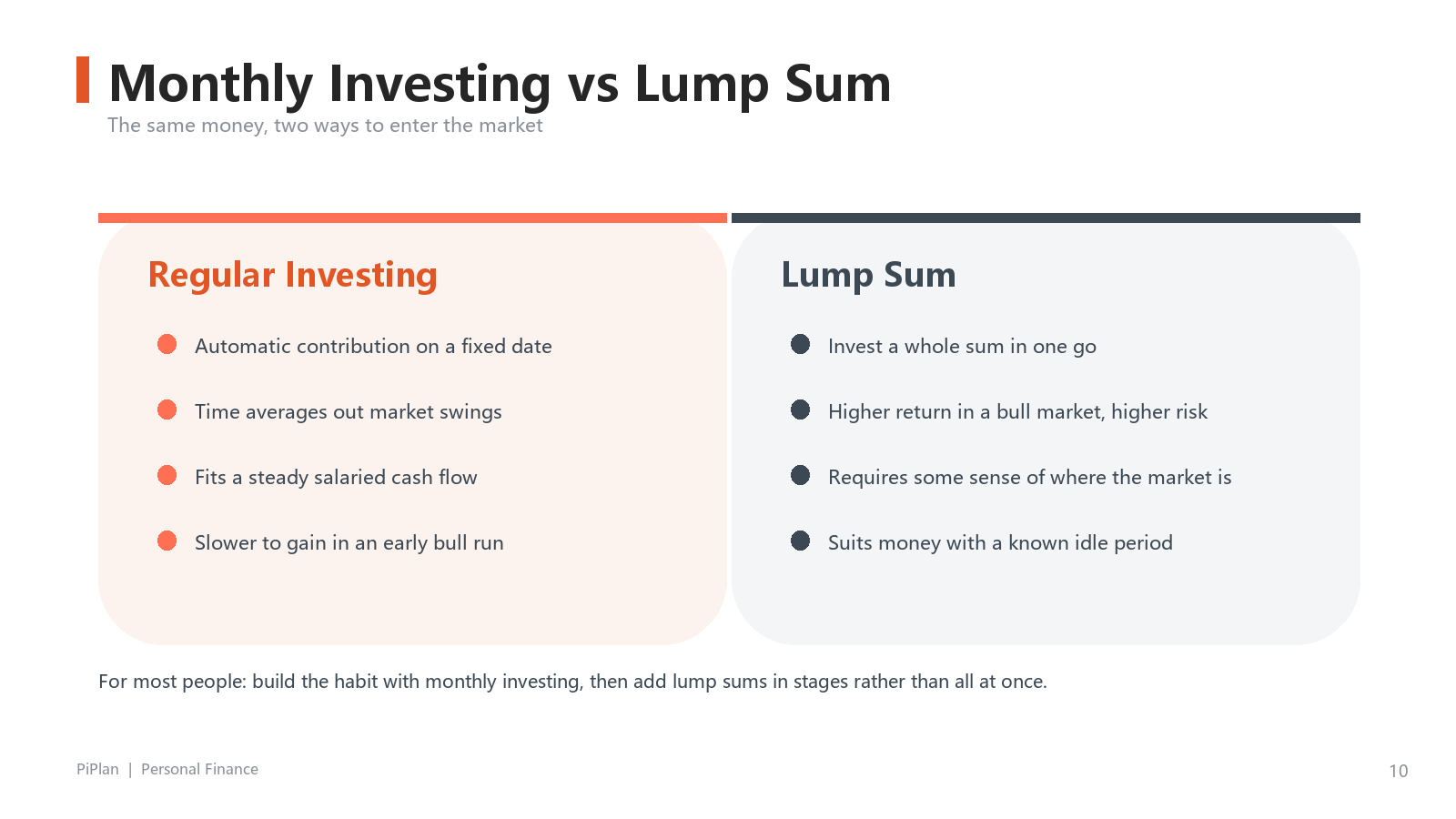
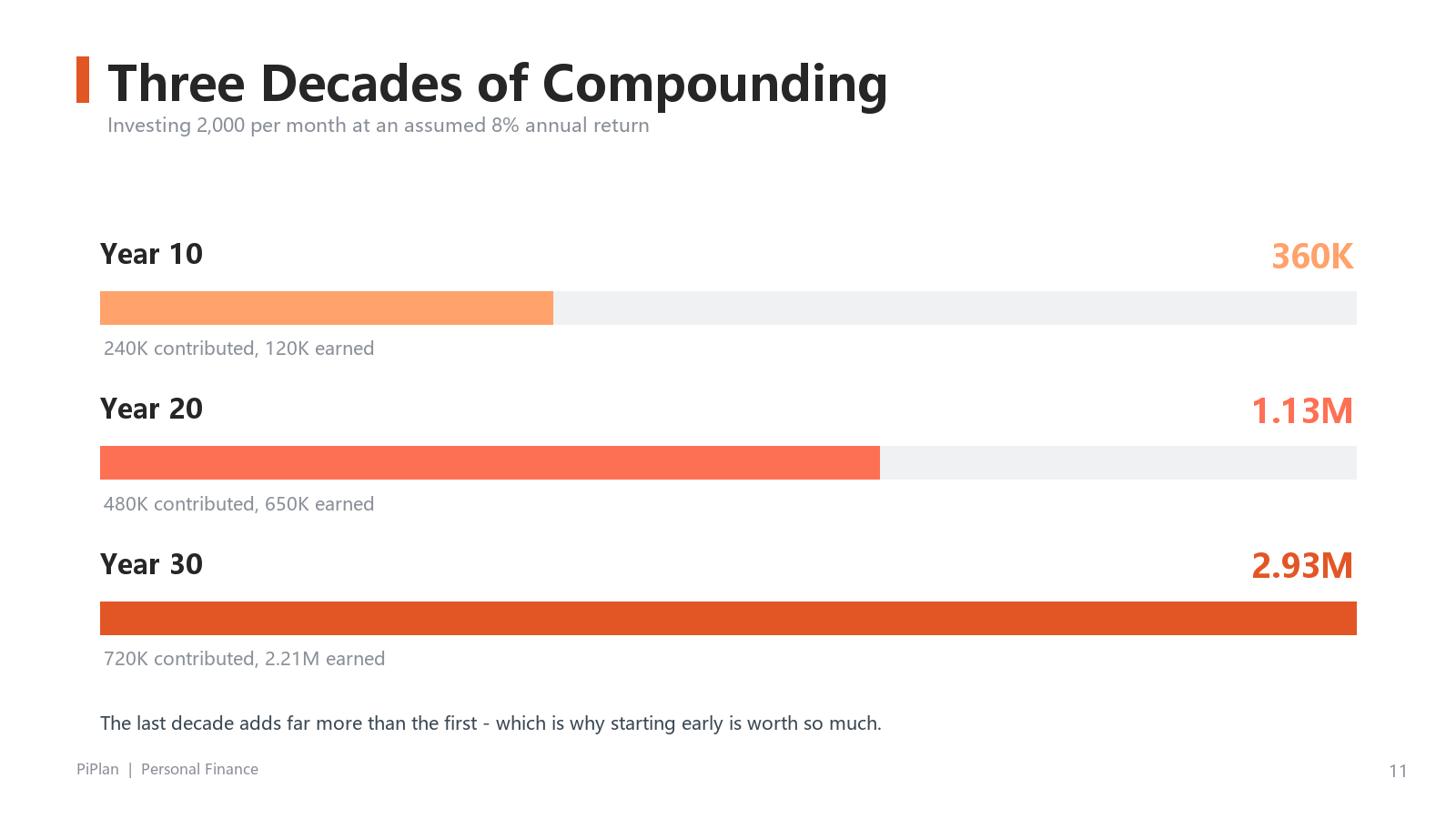
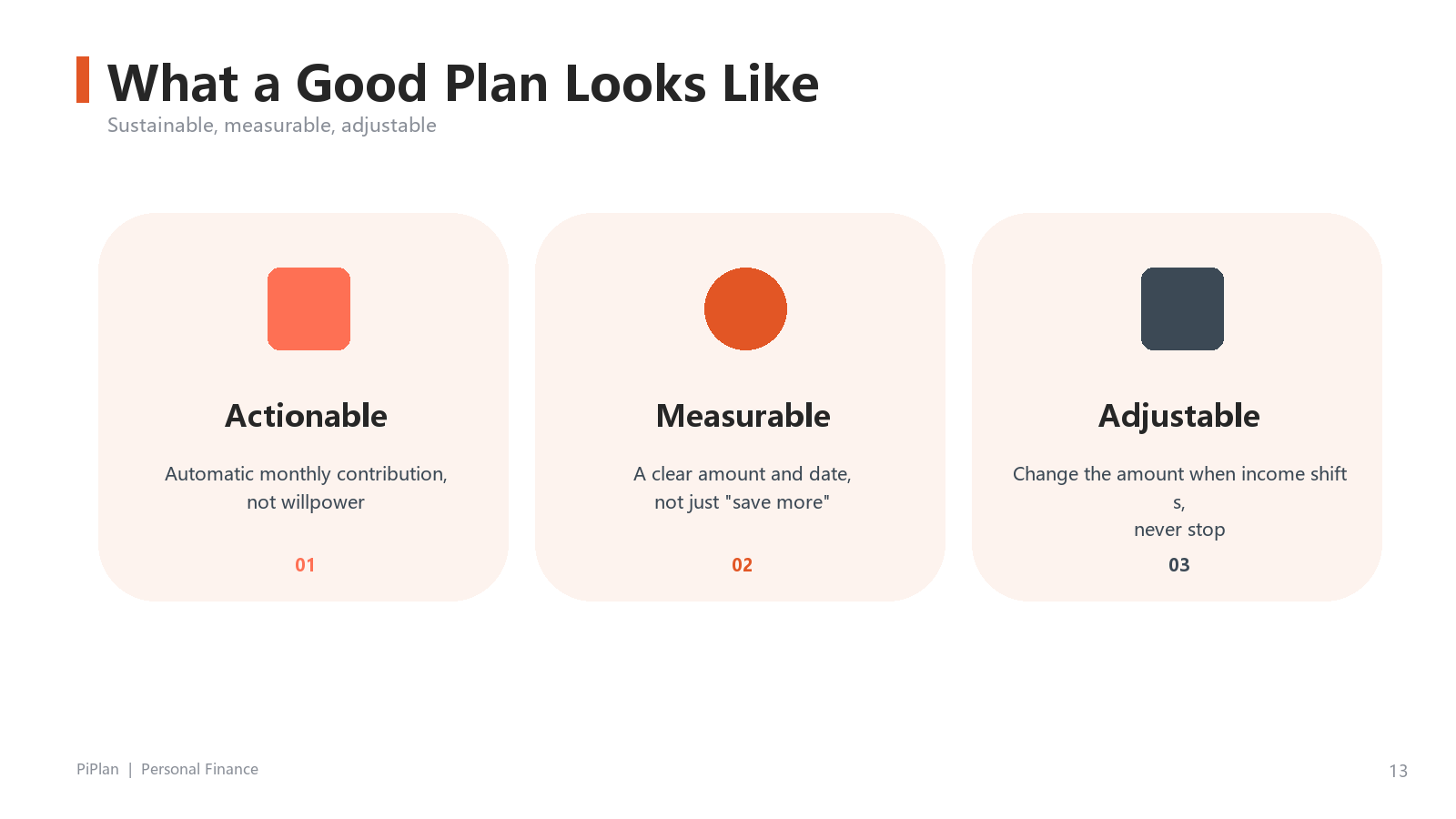
Pages 9–13 — Investing and the case for starting early. A side-by-side comparison weighs monthly investing against a lump sum — automatic contributions and time-averaged volatility on one side, higher bull-market returns and concentrated risk on the other — concluding that most people should build the habit monthly and add lump sums in stages. Three Decades of Compounding makes the strongest argument in the deck with three progress bars: at an assumed 8% annual return, monthly contributions reach roughly 360K by year 10, 1.13M by year 20 and 2.93M by year 30, with earned returns overtaking contributed capital in the later decades. A donut chart shows a 10,000 monthly income split into 5,000 / 2,500 / 1,500 / 1,000, and What a Good Plan Looks Like distils the requirements into three traits — actionable, measurable, adjustable.
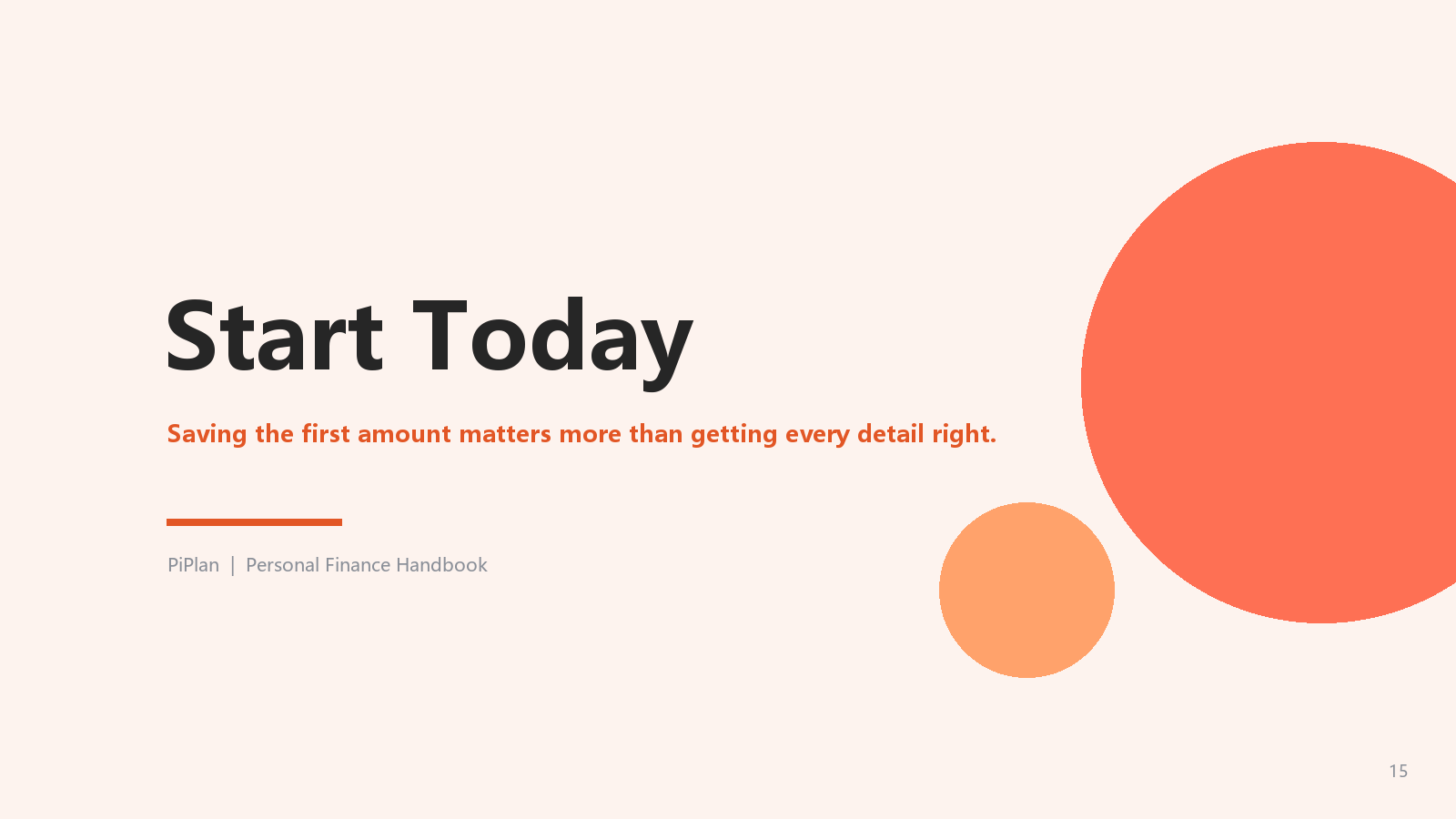
Pages 14–15 — Action and close. The Monthly Action Plan converts everything into five dated habits: move 25% on payday, contribute to an index fund on the 5th, review spending on the 15th, verify the emergency fund quarterly, and rebalance half-yearly. The deck ends on “Start Today” with the line that carries the message: saving the first amount matters more than getting every detail right.
Who It’s For
The deck is written for anyone who earns a regular income and has never had a working system for it — particularly people in their twenties and thirties, early in their careers, who have no significant assets yet and find money disappears without much to show. It assumes no prior knowledge of investing, explains any term it uses, and names no financial product, which makes it safe to present to a general audience.
It also suits people who already save something but without structure: the four-account split and dated action table give shape to habits that were previously ad hoc. Beyond individuals, it fits HR and internal communications teams running financial-wellbeing sessions, employee resource groups, university personal-finance clubs, and anyone preparing a short workshop where the goal is a method rather than a product recommendation. At fifteen pages, each readable in seconds, it suits a twenty-minute talk with time left for discussion — or it can be sent as a self-contained handbook, since the numbers on each page carry the message without a narrator.
One note on scope: the compound-growth figures are illustrative, based on the stated assumption of a fixed monthly contribution and an assumed 8% annual return. They demonstrate the shape of compounding, not a forecast, and a presenter should say so. Readers applying the method with their own numbers can substitute their own income and contribution amounts — the structure does not change, which is precisely the point.

Related Posts

Batteries Industry PowerPoint Template 001

Rail Transit Equipment II Industry Template 001

T3EX Annual Results PowerPoint Template